
 Lumistrips UK
 Lumistrips US
 Lumistrips ES
 Lumistrips ITA
How to Choose a PCB Substrate for Horticulture LED Modules and Grow Lights
-
 By
Lumistrips LED Professional
By
Lumistrips LED Professional
- Apr 20, 2026

Part of the Lumistrips Horticulture LED Series — a technical resource for growers, vertical farm operators, and horticultural engineers.
Why PCB Substrate Is an Engineering Decision, Not a Commodity Choice
When specifying a horticulture LED module, most attention goes to LED component selection and spectral design — and rightly so. But the PCB substrate on which those LEDs are mounted is equally consequential for the outcomes that matter most in a commercial growing environment: how long the system lasts, how consistently it performs over that lifetime, what form factors are possible, and what the total cost of the system is over a 7–10 year operating horizon.
The PCB substrate determines the thermal pathway from the LED junction to the ambient environment — the single most important factor in LED lifetime. It sets the mechanical constraints of the module: whether it must be rigid or can flex, whether it can conform to curved surfaces or only flat mounting structures. It dictates the manufacturing process, the volume thresholds at which different production methods become cost-effective, and the options available for interconnection, waterproofing, and field serviceability.
Lumistrips manufactures horticulture LED modules across the full range of commercially available PCB substrates — FR4 rigid, aluminium rigid, Polyimide (PI) flex, PET flex, and Paper flex — from our ISO 9001, 14001, and 45001 certified production facility in Hechingen, Germany. This article explains what each substrate delivers, where each is best suited for horticulture applications, and how to make the right choice for your specific growing environment.
The Physics That Makes Substrate Choice Critical: Thermal Resistance and LED Lifetime
Before comparing substrates, it is worth understanding the thermal physics that make the choice consequential rather than merely academic.
An LED does not convert all electrical input energy into light. Depending on the component and operating point, typically 20–50% of input power becomes heat at the LED junction — the semiconductor die at the heart of the package. That heat must travel from the junction, through the LED package, through the PCB substrate, and into the heatsink or ambient environment. The total resistance along this path is called the thermal resistance (measured in °C/W), and the PCB substrate accounts for a significant portion of it.
The consequences of elevated junction temperature are well-documented and severe. For every 10°C increase in LED junction temperature above the rated operating point, the useful lifetime of the LED system is approximately halved. Simultaneously, output drops 3–8% for every 10°C increase — meaning a thermally compromised installation is both shorter-lived and dimmer than specified, degrading PPFD delivery progressively from day one.
In a horticulture context running 16-hour photoperiods across a full growing season, this is not a theoretical concern. It is the difference between a system that hits its L80 lifetime specification at 100,000 hours — approximately 17 years at 16h/day — and one that reaches L70 at 30,000 hours, requiring replacement 70% sooner and delivering suboptimal PPFD through the back half of its life.
Substrate thermal conductivity is therefore the first filter to apply when choosing a PCB material for a horticulture LED module. The values below establish the baseline for the comparisons that follow:
| PCB Substrate | Typical Thermal Conductivity (higher is better) | Flexibility | Relative Cost |
|---|---|---|---|
| Aluminium (metal core) | 1.0 – 3.0 W/m·K (board), ~160 W/m·K (metal base) | Rigid | Medium–High |
| FR4 (fibreglass epoxy) | 0.25 – 0.40 W/m·K | Rigid | Low–Medium |
| Polyimide (PI) Flex | 0.15 – 0.20 W/m·K | Flexible | Medium |
| PET (Polyester) Flex | 0.15 – 0.20 W/m·K | Flexible | Low |
| Paper Flex | ~0.05 W/m·K | Flexible | Very Low |
These values immediately reveal the fundamental trade-off in PCB substrate selection: the substrates with the highest thermal conductivity (aluminium) are rigid and moderately expensive; the substrates with the lowest cost and highest flexibility (PET, Paper) have the poorest thermal performance. The right choice is always the one that meets the thermal requirement of the specific application at the lowest system cost — and that determination requires knowing the application's power density, mounting environment, and form factor constraints.
Aluminium PCB: The Standard for High-Power Horticulture Applications

An aluminium PCB — also called a metal core PCB (MCPCB) — uses a thin aluminium base as the structural and thermal foundation, with a dielectric layer and copper circuit layer bonded on top. The aluminium base functions as a built-in heatsink, drawing heat from the LED junction through the dielectric layer and into the aluminium, from which it is conducted to the ambient environment or an external heatsink profile.
The thermal advantage of aluminium over FR4 is substantial — thermal conductivity of the full board is orders of magnitude better — and it becomes decisive in applications where LED power density is high and the ambient environment is warm, as is common in greenhouse and vertical farm operating conditions.
When to Specify Aluminium PCB for Horticulture
Aluminium PCB is the correct specification for high-power horticulture luminaires where continuous operation at high drive currents is required. The specific conditions that point to aluminium include: LED systems running above approximately 3 W per LED, luminaires operating in warm ambient environments (above 30°C at the module mounting surface), applications where the LED density is high and inter-LED spacing is limited, and any installation where meeting an L80 or L90 lifetime specification at 50,000+ hours is a procurement requirement.
In practical greenhouse terms, this covers high-wire supplemental lighting for tomato and pepper (where high PPFD at long operating hours is the design requirement), high-power overhead luminaires in climate-controlled vertical farms, and any module design where the LED components are being driven at or near their maximum rated current.
Lumistrips Aluminium PCB Module Range
Lumistrips manufactures a range of aluminium PCB LED modules specifically designed for high-power applications. The MaxLine series delivers up to 9,000 lm/m on an aluminium substrate with Nichia LEDs, available across the full CRI range (70–99) and colour temperature range (1,800–7,800K) — providing the spectral options needed for horticulture applications from standard supplemental lighting through to high-CRI crop assessment environments. The PowerBar series provides ultra-bright 28 cm aluminium modules with up to 15,000 lm/m, including UV wavelength variants for disease suppression applications. All aluminium modules are lens-ready and manufactured with integrated optics compatibility for applications requiring precise PPFD control.
For horticulture-specific multi-channel designs — red, blue, far-red, and white in custom combinations on an aluminium substrate — Lumistrips' custom module development capability covers the full range of wavelength combinations required for crop-specific spectral engineering.
FR4 PCB: The Cost-Effective Standard for Moderate-Power Applications
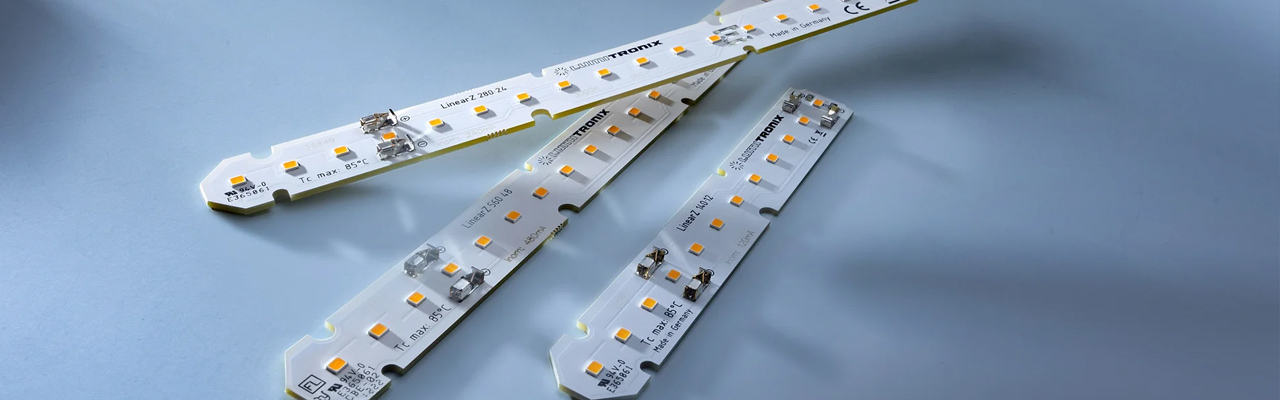
FR4 is the global standard PCB material — a fiberglass-reinforced epoxy laminate that accounts for the vast majority of PCBs manufactured worldwide across all electronics sectors. For LED modules, FR4 offers a proven, well-characterised manufacturing platform with excellent dimensional stability, good electrical insulation properties, and a cost-performance profile that makes it the right choice for a large proportion of horticulture lighting applications.
FR4's Thermal Limitations and How They Are Managed
FR4's thermal conductivity (0.25–0.40 W/m·K) is significantly lower than aluminium. This does not make FR4 unsuitable for horticulture — it means the thermal design of an FR4 module must account for this limitation through appropriate LED power density limits, copper pour design for lateral heat spreading, and adequate spacing to the heatsink profile.
For mid-power LED components — the class that includes most of the LED packages used in supplemental greenhouse lighting strips and linear LED bars — FR4 manages thermal performance adequately when the module is properly designed. The key parameter is the LED junction temperature under worst-case operating conditions: if the design keeps Tj within the LED manufacturer's specified maximum, the lifetime target is achievable on FR4 without the cost premium of aluminium.
When FR4 Is the Right Choice for Horticulture
FR4 is the correct specification for supplemental greenhouse lighting at moderate power densities, intra-canopy inter-lighting bars where the LEDs are run at conservative drive currents, tissue culture and propagation facility lighting where mounting distances are short and LED density is moderate, and any application where cost-per-metre of lighting strip is a critical specification alongside performance.
The rigidity of FR4 is a practical advantage in these applications. FR4 modules are easy to handle during installation, can be mounted directly to aluminium extrusion profiles without thermal interface materials in many configurations, and support integrated connectors, solder pads, and mounting holes that simplify field installation and serviceability. In a commercial greenhouse where lighting strips may be installed and relocated seasonally, the handling robustness of FR4 is a genuine operational benefit.
Lumistrips' FR4 horticulture module designs incorporate integrated plug-and-play connection systems that enable rapid, reliable integration into the full range of greenhouse luminaire formats — from simple supplemental strips to multi-bar overhead assemblies.
The LumiBar series delivers up to 5,000 lm/m on FR4 aluminium substrate with Nichia LEDs, available across the full CRI range (70–99) and colour temperature range (1,800–7,800K) — providing the spectral options needed for horticulture applications from standard supplemental lighting through to high-CRI crop assessment environments.
Polyimide (PI) Flex PCB: Precision Flexibility for Intra-Canopy and Curved Applications
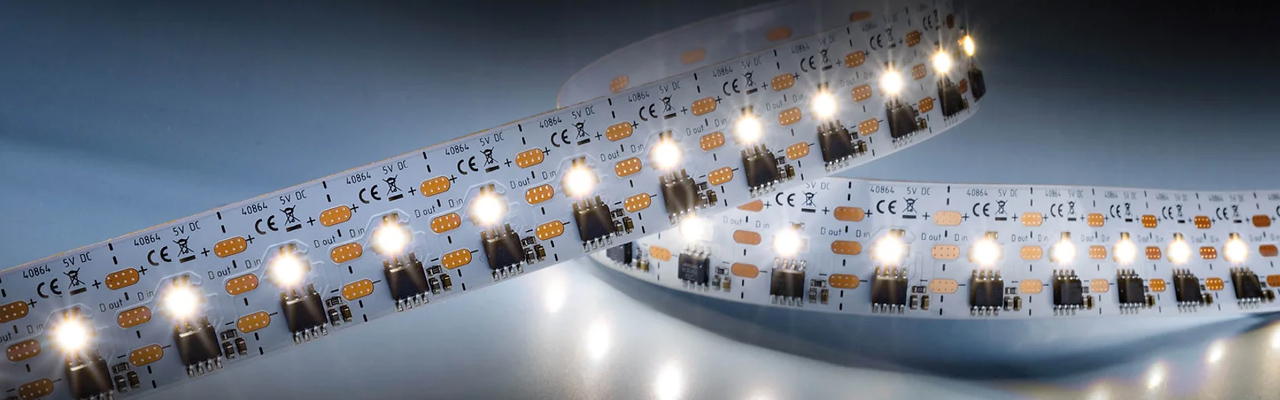
Polyimide — commonly known by the trade name Kapton — is the premium flexible PCB substrate material, used wherever the combination of flexibility, thermal resistance, and long-term durability is required. PI flex PCBs can be bent, curved, folded, and configured into geometries that rigid PCBs cannot approach, opening design possibilities that fundamentally change what horticulture LED module architectures are possible.
PI Flex Properties Relevant to Horticulture
Polyimide maintains its mechanical and electrical properties across a wide temperature range — from cryogenic to above 250°C — making it the correct choice for horticulture environments where temperature cycling, high humidity, and condensation are operating conditions rather than exceptional events. PI is inherently resistant to chemicals, moisture, and the salt-laden aerosols common in hydroponic nutrient systems. Its dimensional stability under temperature variation is superior to PET, meaning connector and solder joint integrity is maintained through seasonal temperature swings in greenhouse environments.
PI flex is the substrate used in Lumistrips' Reel-to-Reel (R2R) Flex manufacturing process for high-performance flexible LED modules. The R2R process enables continuous production of PI flex LED strips in reels up to 100 metres in length and 50 centimetres in width — a unique manufacturing capability in Europe that makes high-volume, consistent-quality flexible LED strip production cost-effective at greenhouse scale.
When PI Flex Is the Right Choice for Horticulture
PI flex is the correct specification for intra-canopy inter-lighting in high-wire greenhouse crops, where the lighting bars must be slender, flexible enough to route between plant rows, and durable enough to operate reliably in the warm, humid environment at mid-canopy height. It is also the right choice for long linear grow lights, bio-reactors, curved mounting structures — cylindrical growing towers, curved grow wall installations, and any geometry where the light distribution pattern requires the LED strip to follow a non-flat surface.
For vertical farm installations where LED strips are mounted in aluminium channels on multi-tier racks, PI flex provides the combination of slim profile, flexibility for routing, and durability under the UV exposure inherent in the growing environment. The ability to produce PI flex strips at lengths up to 100 metres per manufacturing run — without the interconnects that create failure points in manually assembled systems — is a significant reliability advantage for large-area installations.
Reel-to-Reel Manufacturing: What It Means for Quality and Scale

Lumistrips' R2R Flex production process is central to the value proposition of PI flex LED modules for high-volume horticulture applications. The R2R process is fully automated: flexible PCB substrate is loaded as a reel, passes through precision pick-and-place and reflow processes continuously, and exits as finished LED strips on output reels — without manual intervention between operations.
The implications for quality are significant. Automated continuous processing eliminates the process variation and interconnect failures that affect manually assembled flex strips. Solder joint quality is consistent across the full length of a 100-metre production run. LED placement accuracy is maintained to ±0.1 mm across the entire reel. For greenhouse operators deploying hundreds of metres of grow lighting, this consistency directly translates to uniform PPFD across the growing area and predictable system lifetime.
R2R production lot sizes are structured as follows: a full lot covers a 50 m × 500 mm sheet, which yields 25,000 pieces of a 100 × 10 mm LED module, or 2,000 metres of a 1,000 × 12 mm LED strip. Half lots (50 m × 250 mm) are also available. This lot structure makes R2R the economically optimal production method for horticulture projects with defined volume requirements at greenhouse scale.
All Lumistrips R2R Flex production is carried out at our ISO 9001, 14001, and 45001 certified facility in Hechingen, Germany — certifications that are increasingly relevant for horticulture customers operating under food safety quality management frameworks.
PET (Polyester) Flex PCB: Cost-Optimised Flexibility for Lower-Power Applications
PET flex PCBs use polyethylene terephthalate as the substrate material — a lower-cost alternative to polyimide that shares the flexibility advantage while reducing material cost. PET is the substrate used in the majority of the commodity flexible LED strip market, and it is well-suited to a specific segment of horticulture applications.
PET vs. PI: Where the Difference Matters
PET's thermal performance is broadly comparable to PI for low-power applications, but its temperature resistance is significantly lower — PET begins to deform above approximately 80°C, while PI withstands temperatures above 250°C. In horticulture environments where modules are mounted adjacent to high-power LED components or in warm ambient conditions, this distinction matters: PET is appropriate only where the module operating temperature under worst-case conditions comfortably stays below this limit.
PET's moisture resistance and chemical resistance are also somewhat lower than PI, which is relevant in high-humidity greenhouse environments. For applications where the strip will be exposed to direct water spray, condensation cycles, or nutrient mist, PI or a waterproofed PET solution is the appropriate specification.
When PET Flex Is the Right Choice for Horticulture
PET flex is the correct specification for decorative supplemental lighting in retail and display horticulture, low-power photoperiod lighting applications (night-break and day-extension lighting where very low PPFD from a large area is the requirement), and any application where cost-per-metre is the dominant specification criterion and the operating conditions fall within PET's thermal and environmental limits.
For large-area greenhouse installations requiring many hundreds of metres of low-power strip lighting — for example, photoperiod lighting across an entire strawberry propagation facility — PET flex provides an economically viable substrate that meets the thermal requirements of conservatively driven LED designs.
Paper Flex PCB: Sustainable Ultra-Lightweight for Large-Area Low-Power Applications
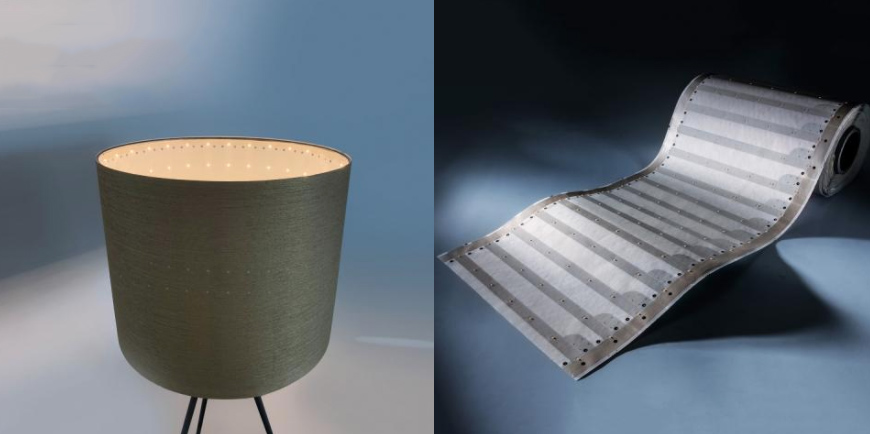
Paper flex PCB is Lumistrips' most innovative substrate offering — a genuinely novel approach to flexible LED strip design that uses paper as the base material rather than plastic film. Developed as part of the Lumistrips R2R Flex product line, PaperFlex LED strips represent the lightest, thinnest, and most sustainably produced LED strip format available.
Paper PCB Properties and Horticulture Suitability
Paper PCBs are touch-safe, extremely thin, and ultra-lightweight — significantly reducing transport and storage costs for large-area deployments. The use of recyclable paper as the substrate material aligns with sustainability objectives that are increasingly important in commercial agriculture, particularly for operators under certification frameworks that include environmental management criteria.
The thermal limitations of paper (approximately 0.05 W/m·K thermal conductivity) restrict Paper PCB to genuinely low-power applications — LED systems where the per-LED power dissipation is minimal. For horticulture, this defines a niche but real application area: very large-area ambient grow lighting at low PPFD levels, decorative and retail plant displays, and wallpaper-style installations where the LED strip must be visually discreet and physically unobtrusive.
Lumistrips PaperFlex: A Commercial Product
Lumistrips manufactures PaperFlex LED strips as a commercial product line — not a prototype or concept. The PaperFlex strips are available with Osram LEDs and can be produced in lengths up to 24.85 metres per strip, at 24V, in warm white (3,000K). For horticulture buyers, PaperFlex is most relevant for supplementary ambient lighting in plant display environments, retail greenhouse spaces, and facilities where the aesthetic integration of the lighting is as important as the photosynthetic output.
Waterproofing: The Additional Layer All Horticulture Modules Need Consideration
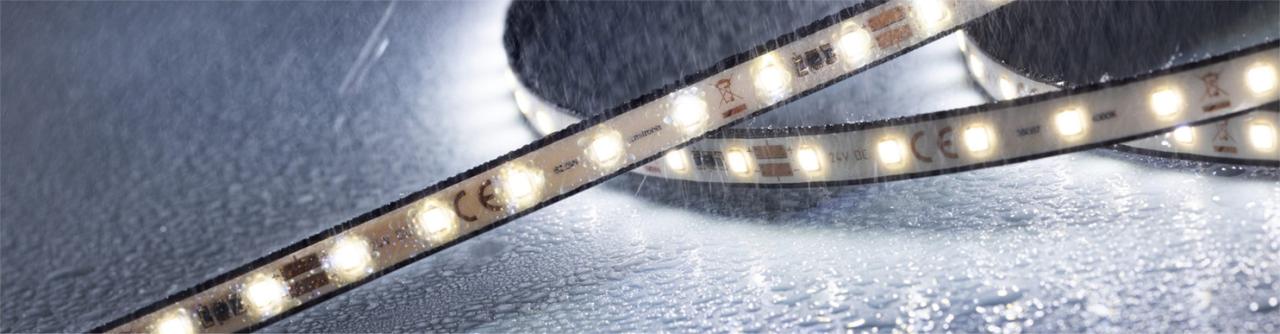
Regardless of substrate choice, horticulture operating environments present a waterproofing challenge that is distinct from most other LED applications. High-humidity conditions in greenhouses — relative humidity regularly above 80–90%, with condensation cycles and direct water exposure from irrigation systems — create an ingress risk for any exposed PCB surface.
Lumistrips' LumProtect IP67 waterproofing process applies a proprietary lamination system that provides certified IP67 protection (complete protection against dust ingress and protection against temporary immersion in water to 1 metre depth) while maintaining the flexibility of the underlying flex substrate. IP67 waterproofed flex modules are the appropriate specification for installations where direct water contact, high-pressure mist irrigation, or regular condensation is expected.
For rigid aluminium and FR4 modules in greenhouse overhead positions where they are sheltered from direct water exposure, IP44 or IP54 protection (provided by the luminaire housing) may be adequate without module-level waterproofing. The appropriate IP rating depends on the luminaire design and the specific installation geometry — this should be assessed for each project.
Substrate Selection Decision Framework
The following framework summarises the substrate selection logic for the most common horticulture LED module applications. Use it as a starting point — the final specification should always be validated against the specific thermal design of the module and the operating environment of the installation.
| Application | Recommended substrate | Key reason |
|---|---|---|
| High-wire greenhouse supplemental lighting (tomato, pepper, cucumber) | Aluminium PCB | High LED power density; long operating hours; L80/L90 lifetime requirements |
| Vertical farm tier lighting — leafy greens, microgreens | PI Flex (R2R) or FR4 | Slim profile required; R2R enables long consistent runs; FR4 if mounting on rigid extrusions |
| Intra-canopy inter-lighting (high-wire crops) | PI Flex (R2R) | Flexibility for routing; durability in humid mid-canopy environment; no interconnects over long runs |
| Tissue culture and propagation room lighting | FR4 | Moderate power; rigid handling advantage; integrated connectors simplify lab installation |
| Strawberry propagation (PFAL) | PI Flex (R2R) or FR4 | Long strip runs per facility; moderate power; R2R provides consistency at scale |
| Curved growing structures (towers, vertical walls) | PI Flex | Only flexible substrate with the durability required for permanent curved installation |
| Photoperiod / night-break lighting (large area, low PPFD) | PET Flex | Very low power dissipation; cost-optimised for large area coverage at low LED density |
| Retail / display plant lighting | PET Flex or Paper Flex | Low power; aesthetics matter; Paper Flex for sustainability credentials |
| UV disease suppression modules | Aluminium PCB | UV LEDs are thermally demanding; aluminium substrate essential for reliable operation |
| Algae Bioreactors | PI Flex (R2R) or FR4 | Slim profile required; R2R enables long consistent runs; FR4 if mounting on rigid extrusions |
How Lumistrips Approaches PCB Substrate Specification
At Lumistrips, substrate selection is treated as an integrated engineering decision — not a catalogue choice. For every horticulture LED module project, we consider the thermal design, up to calculating the expected junction temperature under worst-case operating conditions for the specified LED component, drive current, and ambient environment. That calculation defines the minimum thermal conductivity requirement for the substrate, which in turn constrains the substrate options available. Mechanical and form factor requirements then determine which of those thermally qualified substrates is appropriate, and cost targets and production volume requirements determine the manufacturing process and lot structure.
The result is a substrate specification that is engineered for the application rather than defaulted to the most familiar option — and a module that meets its stated lifetime and performance targets rather than merely aspiring to them.
Our manufacturing capability covers all five substrates described in this article, produced on our SMT and R2R manufacturing lines in Germany. For projects where volume, format, or application requirements place them outside the range of our catalogue products, our development and prototyping team can take a custom specification through from concept to production-ready design.
Need help specifying the right PCB substrate for your horticulture LED module?
Lumistrips manufactures custom horticulture LED modules across FR4, aluminium, PI flex, PET flex, and Paper flex substrates — made in Germany, ISO certified, available in R2R flex and SMT production formats. Talk to our engineering team about your project.
You can also explore our full PCB substrate range and product catalogue at lumistrips.eu/pcb.
← Back to the series: LED Lighting for Horticulture — The Complete Engineering Guide







