
 Lumistrips UK
 Lumistrips US
 Lumistrips ES
 Lumistrips ITA
The LED Component Buyer's Guide for Horticulture: Nichia, Cree, Osram and more
-
 By
Lumistrips LED Professional
By
Lumistrips LED Professional
- Apr 17, 2026

Part of the Lumistrips Horticulture LED Series — a technical resource for growers, vertical farm operators, and horticultural engineers.
Why the LED Component Decision Matters More Than Any Other
Every performance specification in a horticulture luminaire — photon flux output, spectral composition, wall plug efficiency, lumen maintenance, and ultimately the return on capital invested — traces back to a single decision made before the first PCB is laid out: which LED components to use.
The horticulture LED market has matured considerably in the past decade. The five manufacturers that dominate global high-performance LED supply — Nichia, Cree, Osram (ams OSRAM), Seoul Semiconductor, and LumiLeds — have each developed product families specifically engineered for plant growth applications. These are not general-purpose white or coloured LEDs re-labelled for horticulture. They are components characterised in horticulture metrics (µmol/J, PPF, PPFD), designed around plant photoreceptor biology, and tested against the reliability demands of greenhouse and vertical farm operating environments.
The challenge when building the specifications for custom LED module is understanding what manufacturer's portfolio is the right choice for a particular horticulture project. This guide to horticulture LED components addresses that directly, drawing on Lumistrips' two decades of sourcing and specifying components across all major manufacturers.
The Metrics That Matter: Reading Horticulture LED Specifications
Before comparing manufacturers, it is worth establishing the metrics that are meaningful for horticulture applications — because several commonly cited LED specifications are either irrelevant to plant growth or actively misleading when used out of context.
Photosynthetic Photon Efficacy (µmol/J) is the primary efficiency metric for horticulture LEDs. It expresses how many photosynthetically active photons (400–700 nm) are emitted per joule of electrical energy consumed. Higher is better. Current best-in-class coloured LEDs for horticulture achieve 4.0–4.5 µmol/J; white LEDs typically fall in the 2.8–3.5 µmol/J range due to phosphor conversion losses. This metric should be taken into consideration.
Wall Plug Efficiency (WPE), expressed as a percentage, represents the total electrical-to-optical conversion efficiency of the LED package. At 76% WPE, an LED converts 76% of consumed electrical energy into light; the remaining 24% becomes heat that must be managed thermally. For a large greenhouse installation operating 16 hours per day, even a 2–3 percentage point WPE difference between component options compounds into a significant annual energy cost difference.
Photosynthetic Photon Flux (PPF, µmol/s) measures total photon output from a single LED package per second. This is the relevant output metric when calculating how many LEDs are required to achieve a target PPFD over a growing area — and therefore directly determines both module cost and installed fixture count.
Peak wavelength (nm) determines which plant photoreceptors the LED activates. For red LEDs, the difference between 640 nm, 660 nm, and 680 nm is agronomically significant: 660 nm aligns with the Pr-to-Pfr phytochrome conversion peak, the primary photosynthetic red absorption peak of chlorophyll a, and has the most extensive research support for horticulture applications. For blue LEDs, the cryptochrome peak is approximately 449–450 nm. Component selection should reference specific peak wavelengths, not just colour categories.
Lumen maintenance (L70/L80/L90) defines the operational lifetime of the LED system. An LED rated at L70/50,000h means light output has declined to 70% of initial output after 50,000 hours of operation. For a greenhouse running 16h per day, that equates to approximately 8.5 years. Manufacturers differ in how they report — and whether they report — lumen maintenance data, and this has direct consequences for planning lamp replacement cycles and capital expenditure.
Nichia: Photobiology-First Engineering

Nichia is the company that commercialised the blue LED — the foundational component in virtually all modern white LED technology — and their horticulture portfolio reflects two decades of phosphor development applied to plant biology rather than just human vision.
Hortisolis™: Purpose-Built for Plant Growth
The Hortisolis™ series represents Nichia's most specific contribution to horticulture lighting: a white LED engineered not to replicate sunlight for human perception, but to activate all three primary plant photoreceptor systems from a single component package. The spectral design is grounded in the biology: blue content for cryptochrome (stomatal control, stem elongation suppression, compact morphology); red content for phytochrome Pr activation (primary photosynthesis driver); far-red content for phytochrome Pfr and shade avoidance response management; and green content for canopy penetration and worker environment quality.
The practical value of integrating all four wavelength regions into a single package is manufacturing simplicity and spectral consistency. Rather than balancing four separate LED types on a PCB — each with its own binning variation, current requirement, and thermal characteristic — the Hortisolis™ provides a stable, consistent spectral output from a single component. Research has shown yield outcomes from Hortisolis™ that significantly exceed standard white LEDs, with some comparative trials showing growth and yield doubling compared to conventional white LED sources.
The green content in Hortisolis™ also resolves a longstanding operational problem in red/blue LED environments: the purplish light that makes it difficult for workers to visually identify nutritional deficiencies, pest damage, or disease symptoms in plants. Under Hortisolis™ lighting, the grow room environment is approximately white — dramatically improving working conditions and visual crop assessment.
Optisolis™: Maximum CRI for Crop Assessment and Research
Nichia's Optisolis™ series achieves a CRI of 99 — the highest available from any LED manufacturer — through their advanced phosphor and blue chip technology. For horticulture, the primary use case is not production lighting (where photon efficiency dominates the specification) but crop assessment, research environments, and facilities where accurate visual colour rendering of plant tissue, fruit development, or deficiency symptoms is a production requirement. The Optisolis™ spectrum is not optimised for plant photoreceptor activation, but it is unmatched for environments where human visual assessment quality is critical alongside plant growth.
H6 Series: High-CRI Efficiency for Mixed Environments
The Nichia H6 series (CRI90 and CRI95 variants) achieves Ra≥90 with R9≥50 and R15≥96 — metrics that matter for facilities where both plant production and human visual comfort are important, such as retail greenhouse operations, plant display environments, and facilities where staff spend extended periods under the grow lights. Nichia achieves this CRI level without the efficacy penalty that typically accompanies high CRI through their KSF narrowband red phosphor and TriGain® Technology, which optimises the spectral power distribution for both visual quality and energy efficiency.
Cree LED: The Efficiency and Versatility Leader

Cree LED's horticulture portfolio is covering the full range from deep blue through photo red, far-red, and specialised phosphor-converted horticulture LEDs — and it consistently places at or near the top of published efficacy rankings across wavelength categories.
Red LEDs: The 660 nm Efficiency Standard
The Red line represents Cree's current benchmark for 660 nm red LED performance in horticulture. Delivering high, it is one of the components of choice for energy-critical applications where the red channel dominates the spectral design — high-wire greenhouse tomato and pepper cultivation, sole-source vertical farm leafy green production, and any application where electricity cost is the primary operational variable.
Far Red LEDs: Improved Efficiency Gain Over Previous Generation
Cree's current generation Far Red LEDs deliver a efficiency improvement over the previous generation, with a typical wall plug efficiency of 79.2% at 350 mA and 25°C — making them among the most efficient far-red components available at the ~730 nm wavelength critical for phytochrome Pfr activation, dormancy prevention in short-day crops, and the Emerson enhancement effect.
Special Horticulture LEDs: A Category-Defining Innovation
Cree special horticulture LEDs are among the most commercially significant horticulture LED innovations of recent years. It is a phosphor-converted LED — similar in concept to a standard white LED — but with a critical difference: it provides precise, independently tunable control over the green/blue PPF ratio within the white channel output. This is not achievable with conventional white LEDs, where the blue-to-green ratio is fixed by the phosphor and chip combination.
The significance for two-channel (white + red) luminaire designs is substantial. These LEDs enable a 10% efficiency upgrade over conventional white + red systems delivering the same PPF output, or alternatively allows the LED count to be reduced by 50% for equivalent performance. It is also the first horticulture LED component to be characterised natively in horticulture metrics rather than illumination metrics — all published data is in µmol/J and PPF rather than lm/W and lumens, eliminating the conversion step that introduces uncertainty in specification processes.
For luminaire manufacturers currently running two-channel white + red designs, Cree special horticulture LEDs are a component upgrade most likely to materially improve system efficacy without a fixture redesign.
Special view angle LEDs: Architecture for Vertical Farms
The special view angle LED series addresses a specific constraint in vertical farm and close-canopy greenhouse design: mounting distance. Standard high-power LEDs cannot be placed close to the plant canopy without creating hot spots — areas of excessive PPFD that can cause photo-inhibition and leaf damage. These special LEDs beam profile distributes light more broadly, allowing placement up to 40% closer to the plant canopy than standard LEDs while delivering up to 10% higher light levels and maintaining similar uniformity.
In a vertical farm where inter-tier spacing is fixed and maximising the growing area per unit floor space is the primary design driver, the ability to reduce the mounting height of the light bar directly translates into more usable growing layers per metre of facility height. These LEDs are available in all key horticulture wavelengths — photo red, far red, royal blue.
Osram (ams OSRAM): The Red Channel Benchmark

Ams OSRAM is the market leader for red and hyper-red LEDs globally, and their horticulture portfolio is built around that strength. For any application where red channel efficiency is the primary system cost driver — which describes the majority of high-output greenhouse and vertical farm production lighting — ams OSRAM components set the standard against which others are measured.
Hyper Red: Measured Performance Advantage
The current generation Osram Hyper Red delivers a typical radiant flux of at least 1,100 mW and a typical wall plug efficiency of 76% at 700 mA driving current. At 4.51 µmol/J, it is substantially more efficient than white LED alternatives at 3.15 µmol/J for the same photosynthetic photon output.
The system-level implications of improved performance are not trivial. For a greenhouse installation with 1,000 LED fixtures, each consuming 150 W, operating 16 hours per day for 300 growing days per year, a small improvement in WPE reduces annual energy consumption by approximately more than 20,000 kWh — before accounting for the reduced cooling load that results from less heat dissipation.
The practical implication for buyers: every additional percentage of white LED content added to a system that could be served by Hyper Red + Deep Blue increases the total cost of ownership. The freedom to increase Hyper Red content is limited by spectral requirements — crops requiring green or broader-spectrum content cannot be served by pure red/blue — but for red-dominant applications, the TCO data is unambiguous.
Batwing Primary Lens: PPFD Uniformity at Scale
Ams OSRAM's Batwing lens is a primary optic option available across the full Hyper Red, Deep Blue, Far Red, and Horti White product range. The Batwing profile provides a wider radiation pattern than the standard lens — a feature specifically designed for high-wire greenhouse applications where luminaires are mounted well above the canopy and must cover a wide horizontal footprint uniformly.
The direct consequence of better PPFD uniformity from a wider beam is a reduction in the number of luminaires required to cover a given growing area at a target PPFD uniformity specification. Fewer luminaires means lower capital cost, lower installation cost, and lower ongoing maintenance cost. For large-scale greenhouse projects where fixture count runs into the hundreds or thousands, this is a meaningful economic lever in the system design phase.
Deep Blue LEDs: The Optimal Pairing for Hyper Red
Osram's Deep Blue LEDs provide the ~450 nm blue content required to suppress red light syndrome, stimulate cryptochrome, and support balanced plant morphology, while maintaining the high WPE characteristic of non-phosphor-converted coloured LEDs. The blue channel contributes no phosphor conversion losses — unlike white LEDs — which is the fundamental efficiency advantage of two-channel coloured LED systems over white + red architectures.
Seoul Semiconductor: The Natural Spectrum Case

Seoul Semiconductor occupies a distinct position in the horticulture LED market. Their primary contribution is the argument — backed by a decade of in-house cultivation research at their own plant farm — that a spectral power distribution closely matching natural sunlight produces measurable agronomic benefits that efficiency-optimised narrow-band LED systems do not replicate.
SunLike Technology: Purple Emitter Architecture
SunLike LEDs achieve their natural spectrum profile through a fundamentally different chip architecture than conventional white LEDs. Standard white LEDs use a blue emitter chip combined with a yellow phosphor — a design that produces a spectrum with a prominent blue peak and a broad yellow-green emission band, but with gaps in the violet and red regions relative to natural sunlight. SunLike replaces the blue emitter with a purple (violet) emitter, which drives an RGB phosphor mix — red, green, and blue phosphors separately — producing a spectral power distribution that more closely approximates the continuous emission profile of natural sunlight across the 400–700 nm range.
The result is a CRI of 98+ — among the highest available from any LED source — and a spectral distribution that activates plant photoreceptors in proportions more closely matching outdoor solar exposure than any narrow-band or conventional white LED design.
Agronomic Evidence from Cultivation Research
Seoul Semiconductor has operated a dedicated plant cultivation and research farm for over a decade, conducting controlled trials that quantify the agronomic difference between SunLike and standard white LED illumination. Their most extensively published result is the lettuce trial: SunLike full-spectrum lighting produced a 4% yield increase compared to standard white LEDs, alongside a 55% increase in chlorogenic acid and a 31% increase in chicoric acid — both antioxidants with well-documented health benefits and growing commercial value in premium fresh produce markets.
These are not marginal differences. A 30%+ increase in antioxidant content represents a materially different product — one that can be positioned and priced differently at retail. For premium produce operators, vertical farm operators serving health-focused markets, or research institutions investigating nutritional quality, this data point is commercially significant.
Where SunLike Fits in System Design
SunLike is not the highest-efficacy option for maximum PPF per watt — that position belongs to coloured LED combinations like Hyper Red + Deep Blue. SunLike's value proposition is in applications where spectral completeness and nutritional quality premium outweigh the marginal energy efficiency advantage of narrow-band designs. Mixed-crop facilities, premium produce operations, research institutions, and facilities where worker environment quality is a priority are the natural application areas for SunLike-based module designs.
LumiLeds: Reliability and Ecosystem Breadth

LumiLeds' strength in horticulture applications is particularly relevant for projects where supply chain stability and long product lifecycle commitments are critical considerations — large-scale greenhouse operators and vertical farm investors who need confidence that the LED component specified at commissioning will remain available and supportable across a 10+ year facility lifetime. LumiLeds has among the most extensive published photometric and reliability data sets in the industry, and their components are widely used as reference designs by horticultural lighting OEMs.
White LEDs vs. Coloured LEDs: The Efficiency Trade-off Explained
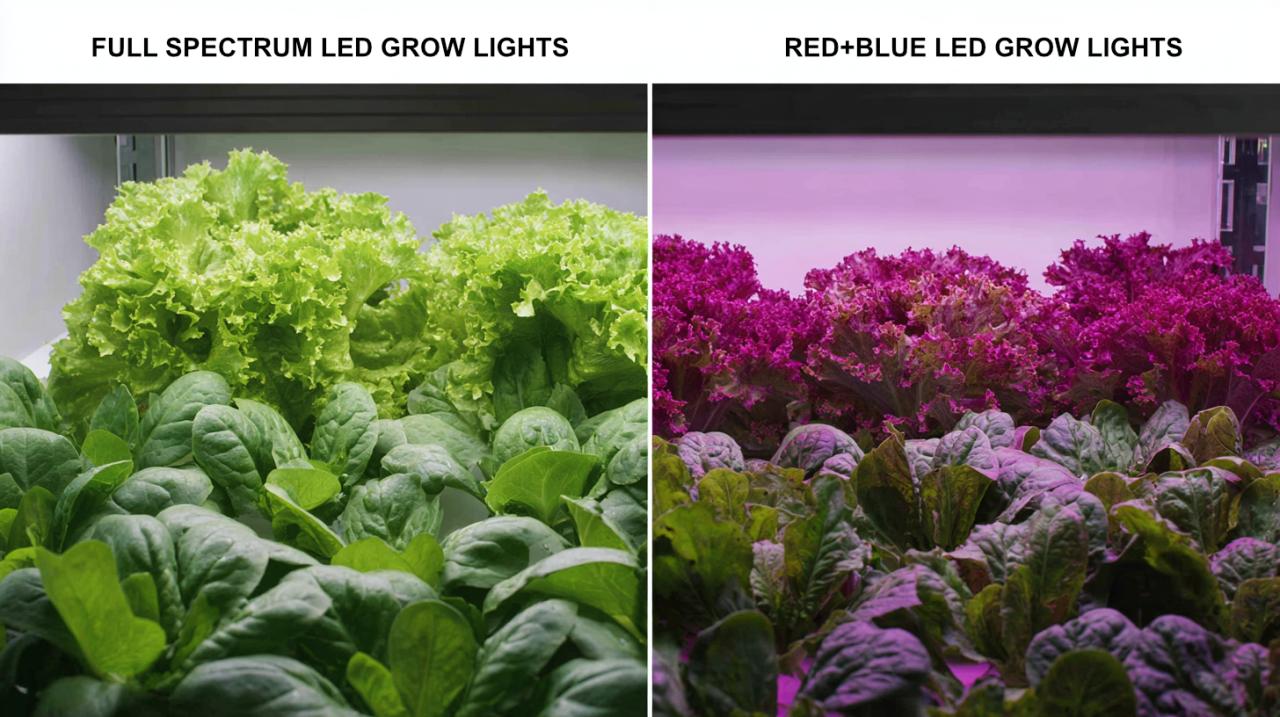
One of the most important and frequently misunderstood technical decisions in horticulture LED system design is the choice between white LEDs and coloured (narrow-band) LEDs. The trade-off is real, it is quantifiable, and it is crop-dependent.
The fundamental physics: white LEDs produce their broad spectrum output through phosphor conversion — a blue or violet LED chip excites a phosphor coating, which re-emits light across a wider spectral range. This conversion process is inherently lossy. The Osram Hyper Red at 4.51 µmol/J versus a white LED at 3.15 µmol/J illustrates the magnitude: white LEDs produce approximately 30% fewer photosynthetically active photons per joule than the best coloured red LEDs at equivalent drive conditions.
However, white LEDs provide something coloured LEDs cannot: spectral completeness, including green wavelengths (490–560 nm) that improve canopy penetration, worker environment quality, and — for some crops — nutritional outcomes and balanced morphology. This is why the market has evolved beyond pure red/blue designs toward LED grow lights with full spectrum white LEDs optionally paired with color LEDs.
The packaging cost dynamic also favours white LEDs in certain applications: white LED packaging costs approximately 20% of the equivalent red LED packaging cost, which can make white + red two-channel designs more cost-competitive for some applications despite the efficacy penalty. Cree's Photophyll™ Select is specifically designed to capture this cost advantage while recovering some of the efficacy lost compared to pure coloured LED designs.
The result is a spectrum of viable system architectures:
- Pure coloured (Red + Blue): Maximum PPE, lowest TCO for red-dominant crops, unsuitable where worker environment quality or green canopy penetration matters. Best served by Osram Hyper Red + Osram Deep Blue.
- Two-channel (White + Red): Broad spectrum from the white channel, boosted red PPF from the red channel. Good spectral balance, moderate efficacy. Best served by Cree Photophyll™ Select + Cree Photo Red S Line, or standard white + Osram Hyper Red.
- Full-spectrum single-component: Maximum photoreceptor coverage from one LED, simplified PCB design, good worker environment. Best served by Nichia Hortisolis™ or Seoul Semiconductor SunLike.
- Multi-channel programmable: Independent control of red, blue, white, and far-red channels. Maximum flexibility across crop types and growth stages. Uses components from multiple manufacturers combined on a single module.
Manufacturer Comparison Summary
The table below summarises the primary differentiation across the five manufacturers for horticulture applications. This is a starting-point reference for system specification — final component selection should be made with reference to specific product datasheets and validated against the target crop's spectral requirements.
| Manufacturer | Primary strength | Best-fit applications |
|---|---|---|
| Nichia | Photobiology-optimised full-spectrum; worker environment quality; phosphor expertise | Vertical farms requiring full-spectrum in single component; mixed-crop facilities; research; premium produce |
| Cree | Widest spectral portfolio; highest red efficacy; | Energy-critical red-channel applications; two-channel luminaire upgrades; vertical farms with close-mount requirements |
| Osram (ams OSRAM) | Market-leading red + hyper-red efficacy; lowest TCO in red-dominant systems; Batwing PPFD uniformity | High-wire greenhouse tomato/pepper; large-scale supplemental lighting; any application where TCO is the primary criterion |
| Seoul Semiconductor | Closest spectral match to natural sunlight; highest CRI available; documented antioxidant / nutritional quality outcomes | Premium nutritional produce; research institutions; mixed-crop facilities; worker environment priority |
| LumiLeds | Supply chain reliability; long product lifecycle commitment; extensive published reliability data | Large-scale long-lifecycle facilities; projects requiring supply continuity guarantees; OEM reference designs |
How Lumistrips Selects and Sources Components

Lumistrips holds direct partnerships and distributor relationships with all five manufacturers described in this article. This is not a procurement convenience — it is the foundation of our ability to design and manfuacture genuinely application-specific LED modules rather than defaulting to whatever component is most readily available.
In practice, the high-performance horticulture modules we design can use LED from more than one manufacturer. A multi-channel module for a high-wire tomato greenhouse might combine Osram Hyper Red as the primary red channel (for lowest TCO) with Cree Far Red (for highest far-red WPE) and Nichia Hortisolis™ (for the white/full-spectrum channel that provides worker environment quality). A single-channel full-spectrum module for a strawberry propagation facility might be built entirely around Nichia Hortisolis™ or Seoul Semiconductor SunLike. A close-canopy vertical farm module for leafy greens might use Cree LEDs throughout to maximise the number of growing layers per metre of facility height.
The selection logic is always driven by the same hierarchy: first, what spectral output does the crop require? Second, which component or combination of components delivers that spectrum at the highest efficacy? Third, which packaging, footprint, and beam profile best matches the mechanical and optical requirements of the luminaire? Fourth, what are the long-term supply chain and lifecycle considerations for the project?
Working through that hierarchy with access to the full portfolio of the world's top five LED manufacturers — rather than being constrained to one supplier's catalogue — is the engineering advantage that translates into better-performing, lower-TCO horticulture lighting systems.
Specifying a horticulture LED module and need component guidance?
Lumistrips works with Nichia, Cree, Osram, Seoul Semiconductor, and LumiLeds to design and manufacture custom LED modules for greenhouse, vertical farm, and specialty horticulture applications. Talk to our horticulture lighting engineers.
← Back to the series: LED Lighting for Horticulture — The Complete Engineering Guide







