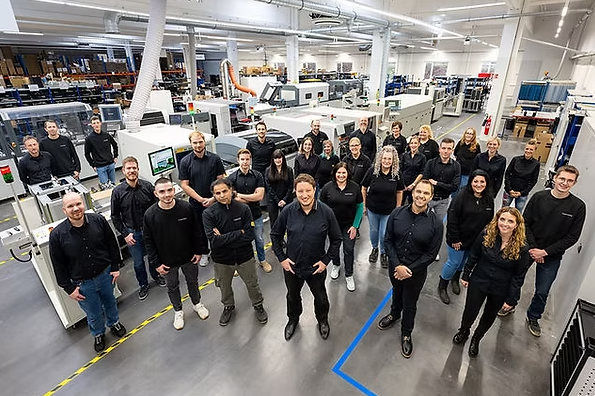
A photo of Lumistrips LED Professional

Lumistrips LED Professional

About the Author: Lumistrips LED Professional

The Lumistrips LED Professional team is the engineering and application knowledge group behind Lumistrips — a German manufacturer of custom LED modules and flexible LED strips with more than 20 years of experience in LED design, development, and production.

Based in Hechingen, Germany, Lumistrips was founded at the beginning of the LED era and has developed alongside the technology since its commercial inception. That longevity is reflected in the depth of the team's application knowledge: from early-generation phosphor-converted white LEDs to today's photobiology-optimised horticulture components, precision optics systems, and intelligent control electronics.

Areas of Expertise

The team writes and publishes on subjects where Lumistrips has direct, hands-on engineering experience accumulated across thousands of projects. Core areas include:

  • Horticulture LED lighting — spectral design for plant growth, PPFD engineering, PCB substrate selection for greenhouse and vertical farm applications, and LED component selection from the world's leading manufacturers including Nichia, Cree, Seoul Semiconductor, Osram, and LumiLeds
  • Custom LED module design and manufacturing — application-specific module development across FR4, aluminium, and flexible PCB substrates, including Reel-to-Reel (R2R) automated flex manufacturing for high-volume production
  • LED optics and light distribution — precision secondary optics from LEDiL, Carclo Optics, Gaggione, and ARI International Corporation, and their application to uniform PPFD delivery, architectural lighting, and specialty illumination
  • High-CRI and full-spectrum LED technology — human-centric lighting, colour rendering accuracy, and natural spectrum LED systems for retail, medical, art, and horticultural applications
  • LED thermal management and lifetime engineering — junction temperature control, lumen maintenance standards (IES LM-80), and system-level design for long operational lifetimes in demanding environments
  • LED drivers and control systems — constant current and constant voltage driver selection, dimming protocols, and spectral sensing for intelligent lighting control

Manufacturing Credentials

Lumistrips designs and manufactures LED modules and strips in Germany, operating both SMT (Surface Mount Technology) production lines and a dedicated Reel-to-Reel flexible LED strip manufacturing facility. The team holds official distributor and partner status with leading LED and optics manufacturers, including authorised distributor relationships with LEDiL and Carclo Optics, and direct supply partnerships with Nichia, Cree, Seoul Semiconductor, Osram, and LumiLeds.

Lumistrips products are supplied to lighting manufacturers, greenhouse operators, vertical farm developers, architectural lighting designers, and research institutions across Europe and internationally. The standard product warranty is five years, with selected LED strip products carrying a seven-year warranty — a direct expression of the confidence the engineering team places in the quality of materials and manufacturing processes used.

Knowledge Base

Content published under the Lumistrips LED Professional authorship draws on a proprietary knowledge base built over two decades of project work, including a systematic review of more than 100 peer-reviewed studies on LED illumination effects in plant growth and horticulture, and a database of more than 1,400 analysed LED lighting systems across application sectors. Articles are written to engineering peer standards — evidence-based, technically precise, and free of generic marketing language.

Lumistrips does not accept sponsored content or paid placement. All product references in articles reflect genuine application experience and manufacturer relationships.

Contact and Collaboration

The Lumistrips engineering team collaborates with lighting manufacturers, agronomists, greenhouse operators, vertical farm developers, architects, and research institutions on custom LED module projects. If you are working on a project and would like to discuss LED system design, contact the team directly.

Lumistrips is part of the Lumitronix Group, headquartered in Hechingen, Germany, with operations in Hong Kong and Romania.

LED Lifetime, Lumen Maintenance, and TCO for Greenhouse Operators of Grow Lights

LED Lifetime and TCO for Greenhouse Operators: Full Guide for Grow Lights

30% of LED grow light manufacturers publish no lifetime data. Of those who do, 45% don't say whether the figure is L70, L80, or L90.

Those aren't equivalent. An L70 system at 40,000 hours is delivering 30% less PPFD than it was on day one. You're paying full electricity costs for 70% of the light.

Our new article gives greenhouse operators the tools to cut through the noise:


→ What L70, L80, and L90 actually mean for crop yield
→ The IES LM-80 standard — and why test duration matters
→ The 5 questions to ask any LED supplier about lifetime
→ A full TCO framework: from HPS vs LED to component choice
→ The €255,000 annual energy cost difference between the
best and worst LED combinations at equal PPF output

Read more

Full Spectrum LEDs vs Red-Blue Grow Lights

Full spectrum vs red-blue grow lights explained. Compare yield, efficiency, crop quality, and spectral strategies for modern horticulture lighting systems.

Full spectrum LED grow lights provide a broader range of wavelengths, including red, blue, green, and sometimes far-red light, enabling more balanced plant growth, better canopy penetration, and improved crop quality. Red-blue grow lights focus on photosynthesis efficiency but may limit plant morphology and lower canopy performance in dense growing systems.

Read more

PPFD Uniformity and Optics: Why Light Distribution Matters as Much as Spectrum in LED Grow Lights

horticulture LED grow light with optics

The most common mistake in horticulture LED lighting isn't the spectrum.
 
It's assuming that because the LEDs emit the right photons, the right photons reach the plants.
 
PPFD uniformity — the consistency of light delivery across the canopy — determines whether a well-specified LED system actually performs as designed or squanders its spectral
investment in hotspots and dark zones.
 
Our new article covers:
 
→ PPF vs. PPFD — the distinction that changes everything
→ Why bare LEDs cannot achieve uniform canopy coverage
→ Primary optics: Osram Batwing and Cree Horizon explained
→ Secondary optics: LEDiL, Carclo, Gaggione, ARI compared
→ Beam angle specification by installation type
→ The economics of getting optics right

Read more

The LED Component Buyer's Guide for Horticulture: Nichia, Cree, Osram and more

LEDs from different manufacturers

Every performance specification in a horticulture luminaire — photon flux output, spectral composition, wall plug efficiency, lumen maintenance, and ultimately the return on capital invested — traces back to a single decision made before the first PCB is laid out: which LED components to use.

The challenge when building the specifications for custom LED module is understanding what manufacturer's portfolio is the right choice for a particular horticulture project. This guide to horticulture LED components addresses that directly, drawing on Lumistrips' two decades of sourcing and specifying components across all major manufacturers.

Read more

LED Grow Light Spectrum by Crop: Lettuce, Tomato, Strawberry & Herbs

LED lighting spectrum engineering for specific crops — lettuce, tomato, strawberry and herbs under horticulture grow lights

There is no single optimal LED spectrum — plant responses to light are species-specific. This article translates more our 20 years experience into LED lighting into practical spectral recommendations for horticulture LED grow lights for lettuce, spinach, kale, basil, pepper, tomato, cucumber, strawberry, and medicinal herbs. Covers red/blue ratios, PPFD targets, far-red guidance by growth stage, and which module architecture fits each crop type.

Read more

LED Lighting for Horticulture - The Complete Engineering Guide

Horticulture LED lighting system in a commercial greenhouse        with custom LED modules above crop canopy

Light controls 90% of plant growth genes — yet most horticulture lighting decisions are still made with the wrong metrics. This guide covers the photobiology behind LED spectrum design, how to evaluate LED components from Nichia, Cree, Osram and Seoul Semiconductor, optics and thermal engineering, PCB substrate selection, and the TCO framework that determines whether a system pays for itself.

Read more

CRI Requirements for Specialty Lighting: Why Nichia Optisolis and H6 Series Are the Best Choice

What Is CRI and Why Is It Important in Specialty Lighting?


CRI Requirements for Specialty Lighting: Why Nichia Optisolis™ and H6 Series Are the Best Choice

When it comes to specialty lighting—from museums and galleries to medical spaces and premium retail—the quality of light is critical. A key factor in achieving visually accurate and functional lighting is the Color Rendering Index (CRI).

In this article, we explore what CRI means, why it matters, and how Nichia’s Optisolis™ and H6 Series LEDs, combined with our custom LED modules, offer the ultimate lighting solution.

Read more