
 Lumistrips UK
 Lumistrips US
 Lumistrips ES
 Lumistrips ITA
Optical Design in Horticulture LED Lighting
-
 By
Lumistrips LED Professional
By
Lumistrips LED Professional
- May 28, 2026

Optical Design in Horticulture LED Lighting: why where the light lands matters
Spectrum selection gets most of the attention in horticulture lighting discussions, and for good reason. The research on red, blue, far-red, and green wavebands and their effects on photoreceptors is rich and growing. But there is a parallel engineering challenge that receives far less scrutiny, and it quietly determines whether an otherwise excellent spectral recipe actually delivers results at the plant: optical design.
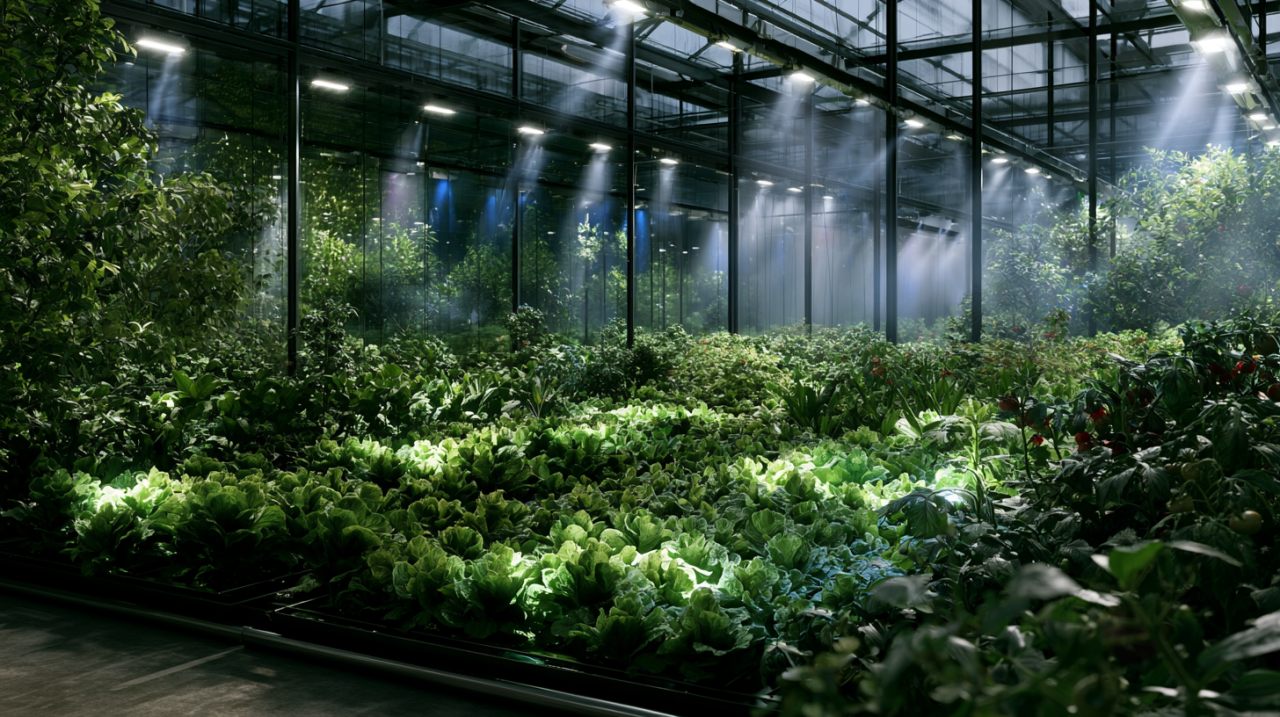
The best LED at the right wavelength, operating at the right intensity, accomplishes very little if its photons consistently miss the canopy, pile up in hotspots while adjacent areas starve, or scatter uselessly beyond the growing zone. Getting the light to the right place, with the right angular distribution, at the right density across the whole canopy is the optical problem. And solving it requires deliberate engineering choices at every level of the luminaire design.
The problem with point sources and bare LEDs
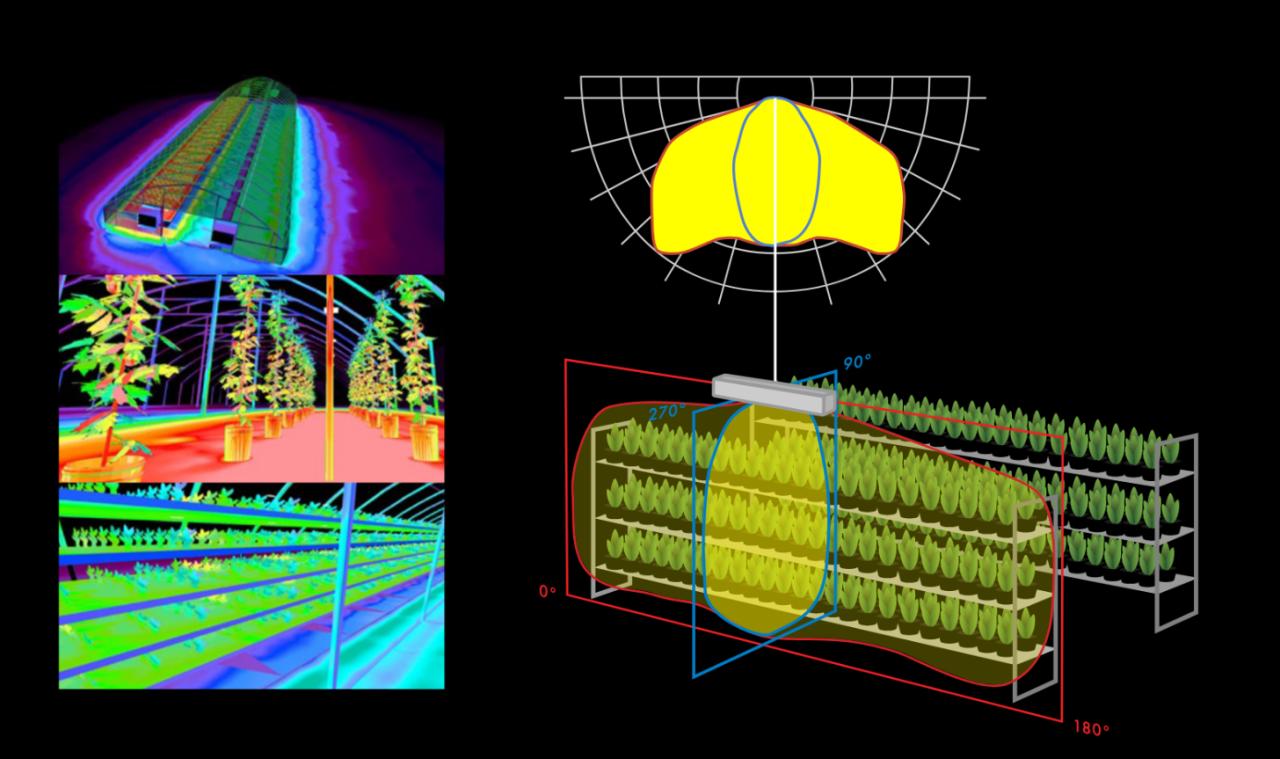
A single LED is a point source with a roughly Lambertian emission profile where intensity peaks at nadir and falls off with the cosine of the angle. Mount a row of these above a flat canopy, and you get a superposition of overlapping cosine lobes: a hot stripe of high PPFD directly below each fixture, dropping off rapidly toward the edges of the growing bed.
The consequence is measurable and economically significant. Research on canopy photon capture efficiency shows that as the illuminated field becomes smaller relative to the growing area, an increasing fraction of emitted photons miss the canopy or arrive at angles too oblique to contribute meaningfully to photosynthesis. Conversely, optimizing the angular distribution of the light source to better match the growing footprint directly improves the fraction of generated photons that do useful work.
This is not an abstract efficiency metric, it translates directly into energy cost per gram of harvested biomass. In vertical farming, where artificial light is the sole energy input for photosynthesis and electricity dominates operating expenditure, even a 10–15% improvement in optical delivery efficiency has real payback implications across a production cycle.
Primary Optics: the LED Package sets the first constraint
Before secondary optics enter the picture, the angular emission characteristics are already set by the LED package. Standard dome-lens LEDs produce a viewing angle (half-intensity angle) of roughly 60–70°, resulting in a near-Lambertian spatial distribution. At close mounting distances typical of vertical farming, for example 10–30 cm canopy-to-fixture, this broad emission cone creates significant overlap between adjacent LEDs and steep gradients toward the tray edge.
The industry has responded with batwing and horizon optics integrated directly into the LED package. Instead of a peak at nadir, batwing-profile LEDs redirect peak intensity laterally, producing dual-lobe maxima displaced 70° or 90° from center. The practical effect is a significantly flatter PPFD distribution across the growing surface from the same fixture geometry.
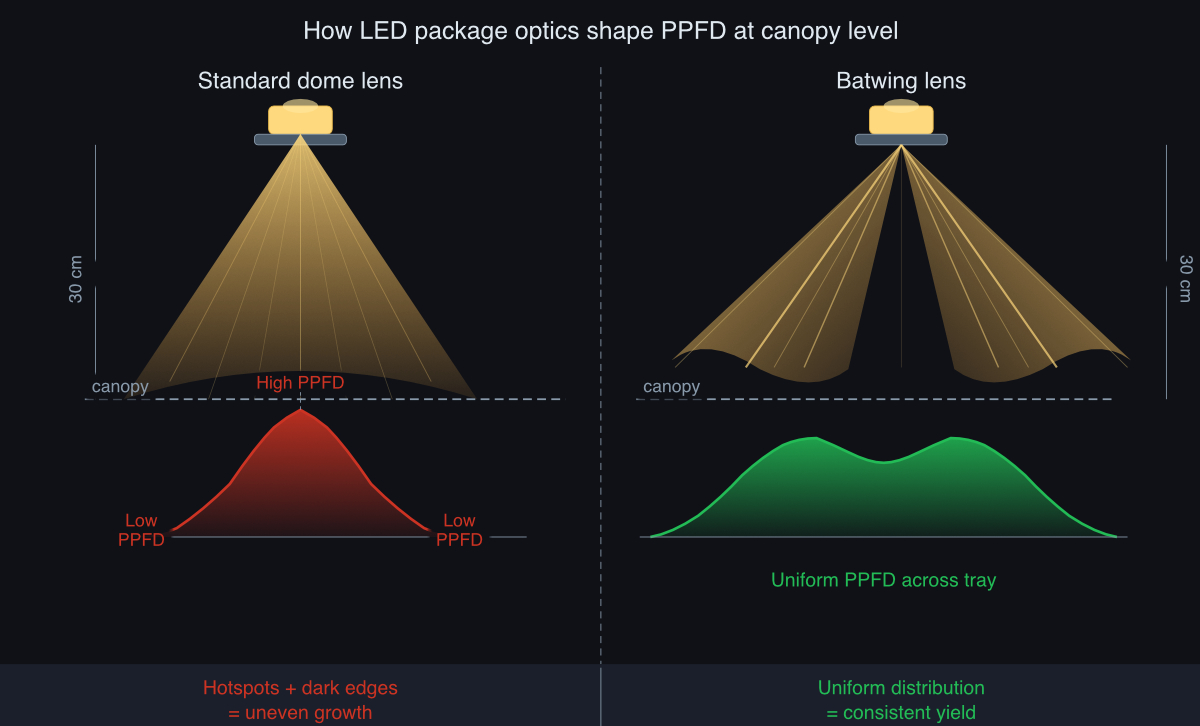
Cree's XLamp Horizon series enabling fixture mounting heights up to 40% lower than conventional dome-lens configurations at equivalent PPFD uniformity. For vertical farm operators, lower mounting height means reduced rack spacing, which translates directly to higher canopy density per floor area. OSRAM's Batwing LEDs apply the same principle across the horticulture wavelength range: Hyper Red (660 nm), Deep Blue (450 nm), Far Red (730 nm), and White.
The takeaway for system designers: primary optic selection is not downstream of LED selection but a part of it. Specifying a 660 nm hyper red LED without specifying the package lens geometry leaves a major optical variable undefined.
Secondary Optics: Shaping, Confining, and Redistributing
For many horticulture applications, especially top-lighting in commercial greenhouses and intercanopy lighting in high-wire tomato and cucumber cultivation, secondary optics are the primary tool for controlling beam geometry.
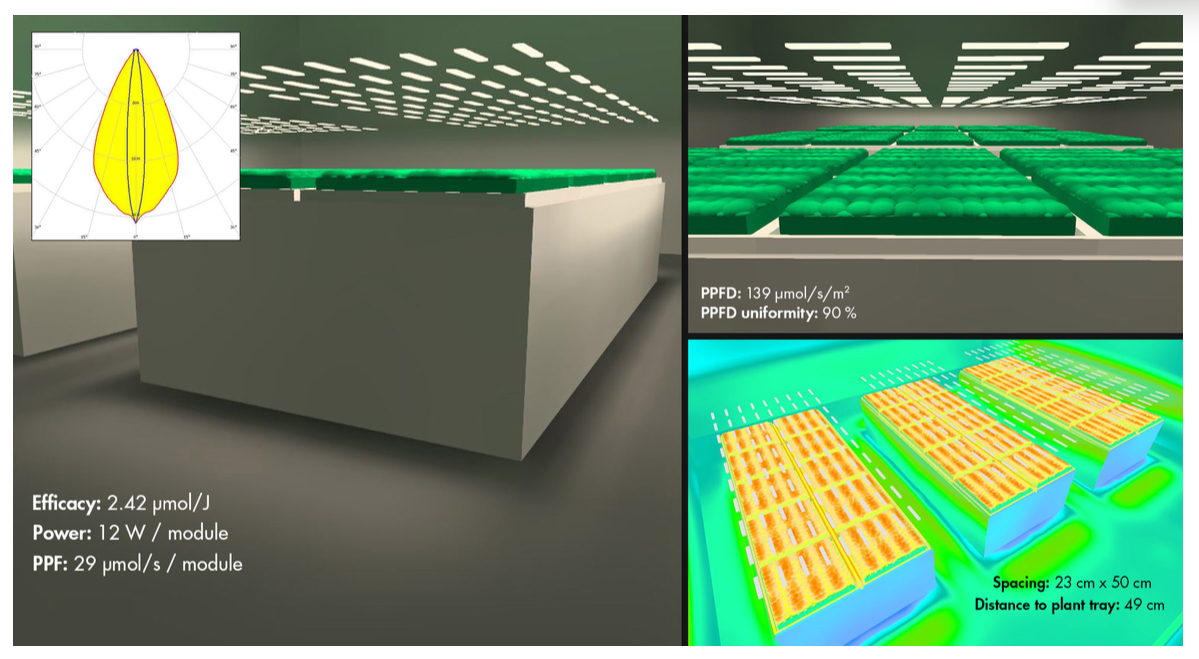
Secondary optics mounted over or around the LED package are individual TIR lenses, multi-LED lens arrays, reflectors, or diffusers that perform several distinct functions:
Beam narrowing for long-throw applications. In greenhouse top-lighting installed 3–5 meters above the canopy, bare LEDs produce an unacceptably wide cone with severe edge falloff. A narrower beam concentrates output into a tighter angle, maintaining useful PPFD levels across a larger canopy area from the same fixture.
Uniformity correction. A fixture designed with a mix of beam angles over different LED positions can deliberately compensate for the center-heavy distribution of a naive array, flattening the PPFD profile across the growth area.
Lateral emission for interlighting. LED modules positioned within a tomato or pepper canopy need to push light sideways into leaf surfaces, not primarily downward. Side-emitting or asymmetric secondary lenses redirect flux into the lateral plane, reaching interior canopy leaves that receive no direct overhead light.
Edge compensation for vertical farm trays. At the boundaries of a growing tray, fixture arrays produce a visible PPFD drop. Secondary optics can direct additional flux toward the tray perimeter, reducing the gradient and the resulting growth differential between center and edge plants.
The optical efficiency of secondary components is a real cost, for example high-quality PMMA or PC lenses introduce transmission losses typically in the range of 5–12% depending on material, geometry, and the number of optical surfaces. This loss must be weighed against the uniformity and delivery efficiency gains the optics provide. The photosynthetic photon efficacy at the crop surface, not the LED in isolation, is what determines system performance.
LEDiL: Engineering the Optics for Horticulture
Lumistrips is an official engineering partner of LEDiL, a Finnish optical components manufacturer that has built one of the most comprehensive optics portfolios specifically addressing the geometry and environmental challenges of horticultural lighting. The following are the families most relevant to growers and luminaire designers.
The LEDiL horticulture portfolio includes several optic families optimized for different cultivation geometries and environmental conditions.
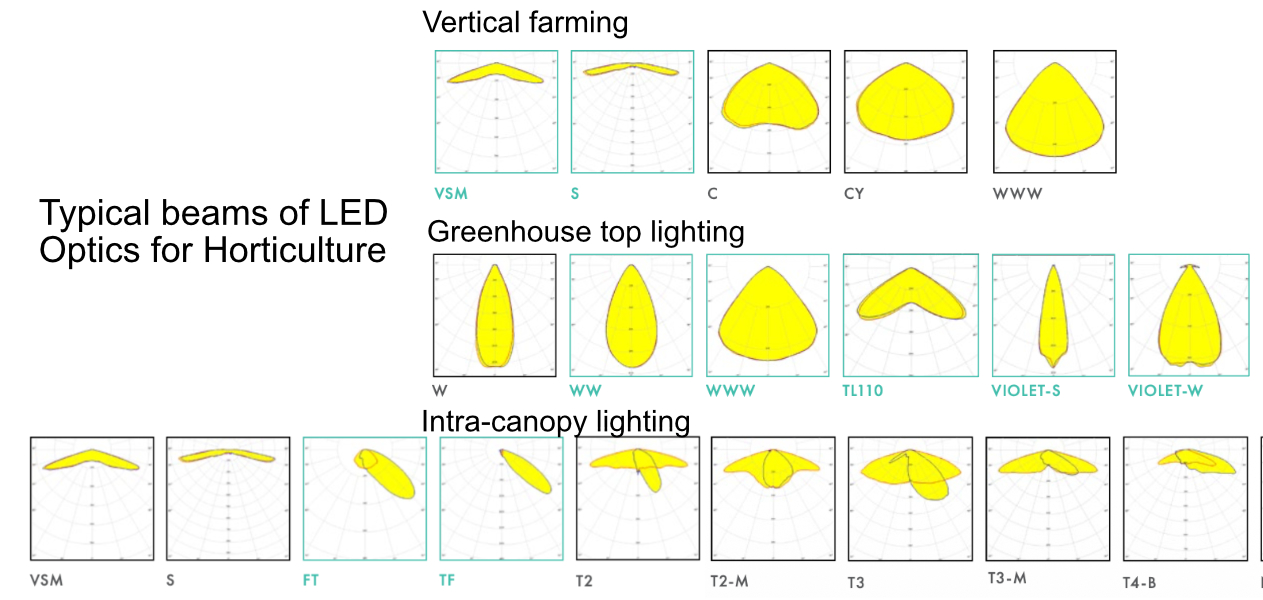
The DAHLIA family is designed for greenhouse toplighting and large-area cultivation systems. Its linear multi-lens architecture provides highly uniform PPFD distribution across wide growing areas while minimizing hotspots and improving canopy penetration. Wide-beam versions are ideal for supplemental greenhouse lighting, while narrower variants support higher mounting distances and targeted photon delivery.
For vertical farming applications, DAHLIANNA extends the same concept into multilayer cultivation systems where fixture-to-canopy distances are extremely short and PPFD uniformity becomes critical. The optics are optimized for continuous linear modules and help improve tray-to-tray consistency, crop uniformity, and photon utilization efficiency.
The compact PETUNIA and PETUNIA2 optics are designed for space-constrained greenhouse fixtures where minimizing fixture shading is important. Their compact form factor enables efficient beam control while reducing obstruction of incoming sunlight in supplemental lighting environments.
For applications requiring tighter beam shaping and more directional photon control, the VIRPI family offers multiple beam-angle options optimized for different mounting heights and cultivation geometries. VIRPI optics are particularly useful in mixed-spectrum horticulture systems using combinations of red, blue, white, and far-red LEDs.
In harsh greenhouse environments, the FLORENCE-3R-IP family provides IP67-rated optical systems designed to withstand humidity, condensation, agrochemicals, and regular wash-down cycles. These optics are especially suitable for interlighting and intracanopy applications in tomato and cucumber production.
For emerging UV horticulture applications, LEDiL also offers the VIOLET family, developed using specialized UV-resistant optical materials for UV-A and UV-C systems used in pathogen suppression and secondary metabolite enhancement.
Together, these optical platforms allow horticulture lighting systems to deliver better PPFD uniformity, improved canopy penetration, reduced photon spill losses, and higher overall crop productivity. In modern controlled-environment agriculture, optics are no longer an accessory — they are a core part of horticulture lighting performance.
Application-Specific Optical Strategies, with specific optics
Vertical Farming (Sole-Source)
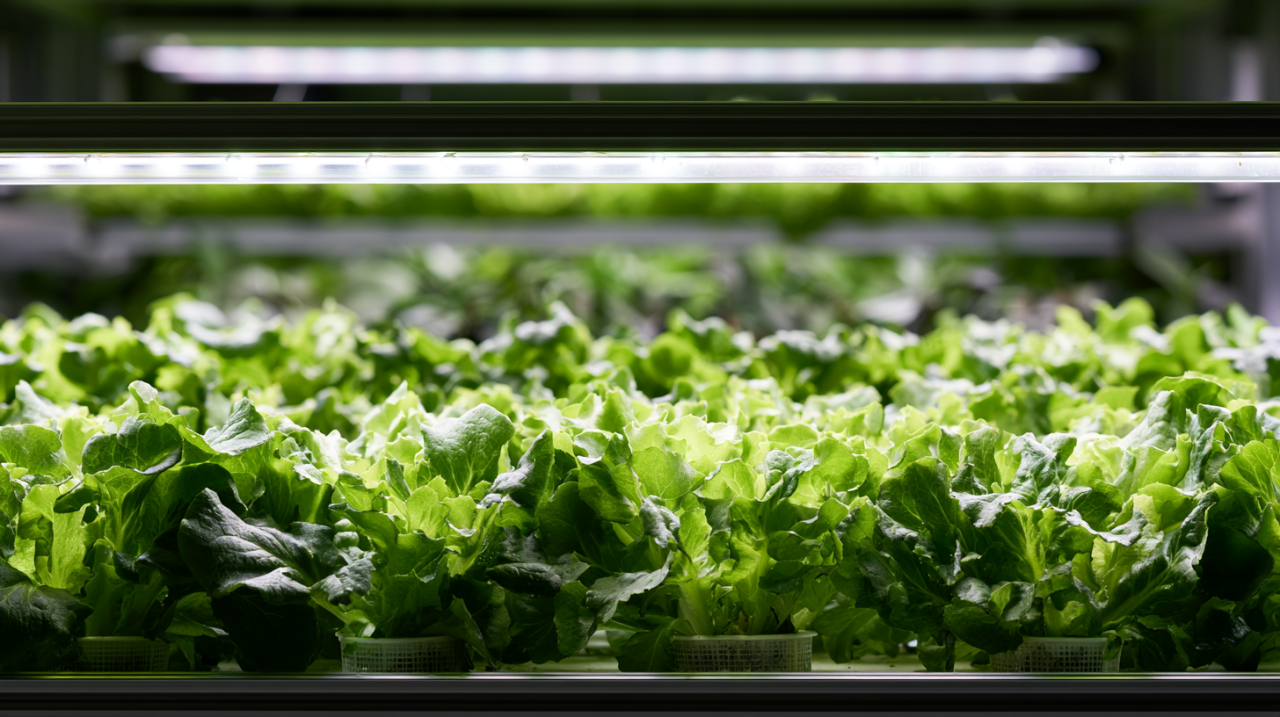
The geometry here is demanding: fixtures sit very close to the canopy (10–30 cm), the growing area is precisely bounded by tray or rack geometry, and uniformity requirements are tight because any PPFD gradient produces visible growth differentials in fast-growing leafy crops.
Optimal approach: DAHLIANNA for new-build linear modules requiring maximized efficacy, or DAHLIA-TL with a wide-beam (TL110 or VSM) variant where standard 3535 LED compatibility is needed. Batwing-profile LEDs (Cree or OSRAM) reduce the required number of fixtures by enabling lower mounting heights. The primary design variables are module pitch and LED density; secondary optics impose relatively little loss because mounting heights are short and beam-shaping requirements are modest.
Greenhouse Top-Lighting
Mounting heights of 2–5 m, large growing areas, and variable daylight interaction make this the most optically complex scenario. DAHLIA-TL110 is LEDiL's recommended best-match for this application, with documented simulation data showing 95.3% center-tray uniformity at 3.2 m as a concrete reference point. For applications where fixture profile must be minimized to avoid shading, PETUNIA allows more compact fixture designs while retaining good beam control at intermediate mounting heights.
At very high mounting distances or where fixture spacing is forced by structural constraints, VIRPI-S or VIRPI-M at 15° and 30°, respectively, concentrates flux enough to maintain target PPFD at canopy. The trade-off is tighter fixture spacing requirements to avoid dark bands between fixture footprints.
Interlighting (Intracanopy)
For LED modules threaded between plant rows in high-wire tomato and cucumber cultivation, the optical requirements invert: maximum lateral emission, minimal downward waste flux. FLORENCE-3R-IP with the Z90 or oval (O) beam option pushes flux laterally into side-facing leaf surfaces. The Zhaga Book 7 compatibility also simplifies integration with standard mid-power LED modules.
The Uniformity Metric That Actually Matters: PPFD, Not Lux
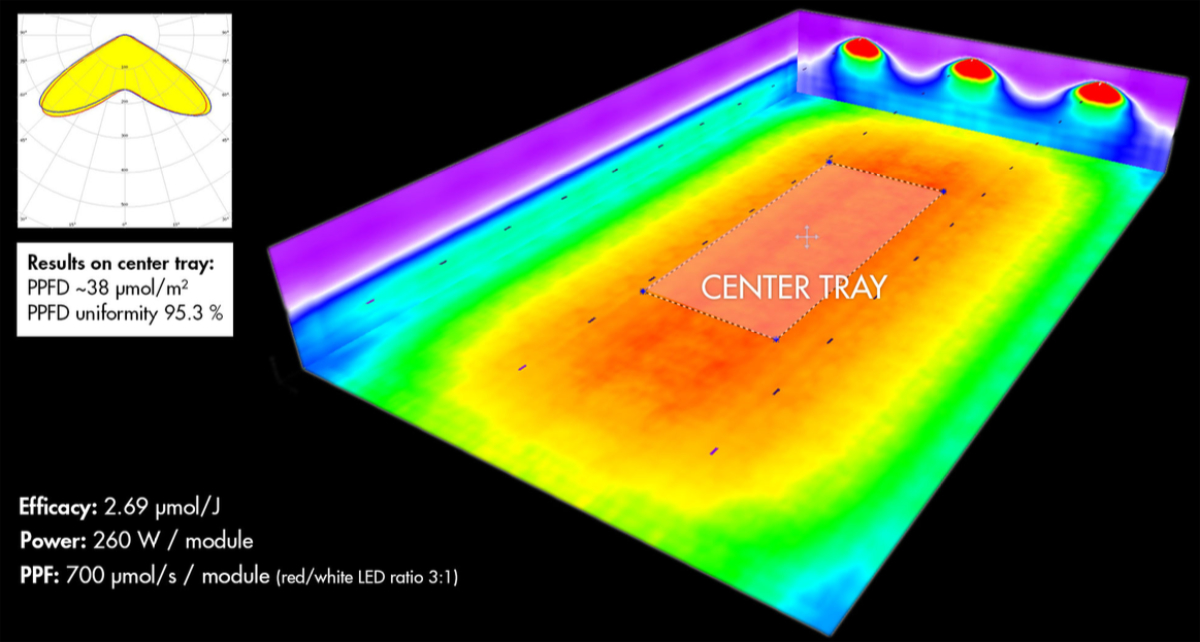 A persistent source of confusion when evaluating optical designs: uniformity in horticulture is properly measured in PPFD (µmol/m²/s), not illuminance (lux). Lux is weighted to human photopic vision and is essentially irrelevant to plant response. A hyper red LED at 660 nm contributes significant photosynthetically active radiation but registers almost nothing on a standard photometer.
This distinction becomes critical when interpreting supplier specifications. A fixture that appears reasonably uniform in lux, because it includes enough white light to move a photometer, may be deeply non-uniform in the red and far-red bands that drive photosynthesis. Any optical design evaluation for horticulture must be conducted in PPFD, channel-resolved where multi-channel recipes are involved.
A product characterization methodology that provides uniformity ratios (Uo) in terms of irradiance or PPFD across defined tray geometries, rather than lux-based uniformity indices, is the correct approach.
The importance of Optics in Horticulture LED Module Design
Our partnership with LEDiL goes beyond component access. LEDiL provides photometric files in IES and LDT format for every optic variant, a necessary input for simulation-based optical layout work using tools such as DIALux or Relux. Correct simulation requires accurate photometric data for the optic-LED combination as a system; simulating with LED data alone, or with generic lens assumptions, produces layout results that will not match measured installation performance.
LEDiL's technical support team also runs application simulations on request, producing PPFD uniformity maps for proposed fixture configurations before hardware is committed. This is standard practice for professional horticulture projects and significantly reduces the risk of installing a system that performs below target at canopy level.
As an official LEDiL partner, Lumistrips brings this full stack to horticulture projects: optic selection, LED-optic co-characterization, module integration with thermally appropriate PCB substrates, and access to simulation support before design freeze.







