
 Lumistrips UK
 Lumistrips US
 Lumistrips ES
 Lumistrips ITA
PPFD Uniformity and Optics: Why Light Distribution Matters as Much as Spectrum in LED Grow Lights
-
 By
Lumistrips LED Professional
By
Lumistrips LED Professional
- Apr 22, 2026

Part of the Lumistrips Horticulture LED Series — a technical resource for growers, vertical farm operators, and horticultural engineers.
The Overlooked Half of Horticulture Lighting Design
Significant attention in horticulture LED system design goes into selecting the right spectrum — the precise wavelength ratios, the red-to-blue balance, the far-red component, the white channel content. That attention is warranted. But it addresses only what the LEDs emit. An equally consequential question is almost always given less rigour: where do those photons actually land?
A luminaire can be engineered with the ideal spectral output, the most efficient LEDs, and the correct PPFD for the target crop — and still deliver poor agronomic results if the light distribution across the canopy is uneven. Zones of excess PPFD waste energy and can induce photoinhibition. Zones of deficient PPFD suppress photosynthesis. The net result is a canopy that performs below its biological potential while consuming the same electrical energy as a properly designed system.
Research on canopy photon capture efficiency demonstrates this clearly: the fraction of emitted photons that the canopy can actually use decreases as the lighting fixture footprint becomes smaller relative to the growing area, and increases as the installation becomes more spatially prominent and evenly distributed. Non-uniform PPFD makes wasted electricity inevitable, regardless of how efficient the LED components themselves are. Getting light distribution right is an optical and installation design problem — and it must be addressed at the module specification stage, not after installation.
This article covers the physics of PPFD uniformity, the optical tools available to achieve it, how requirements differ across greenhouse and vertical farm installation geometries, and how Lumistrips integrates optics from the world's leading manufacturers into horticulture module designs.
PPF vs. PPFD: The Distinction That Changes Everything
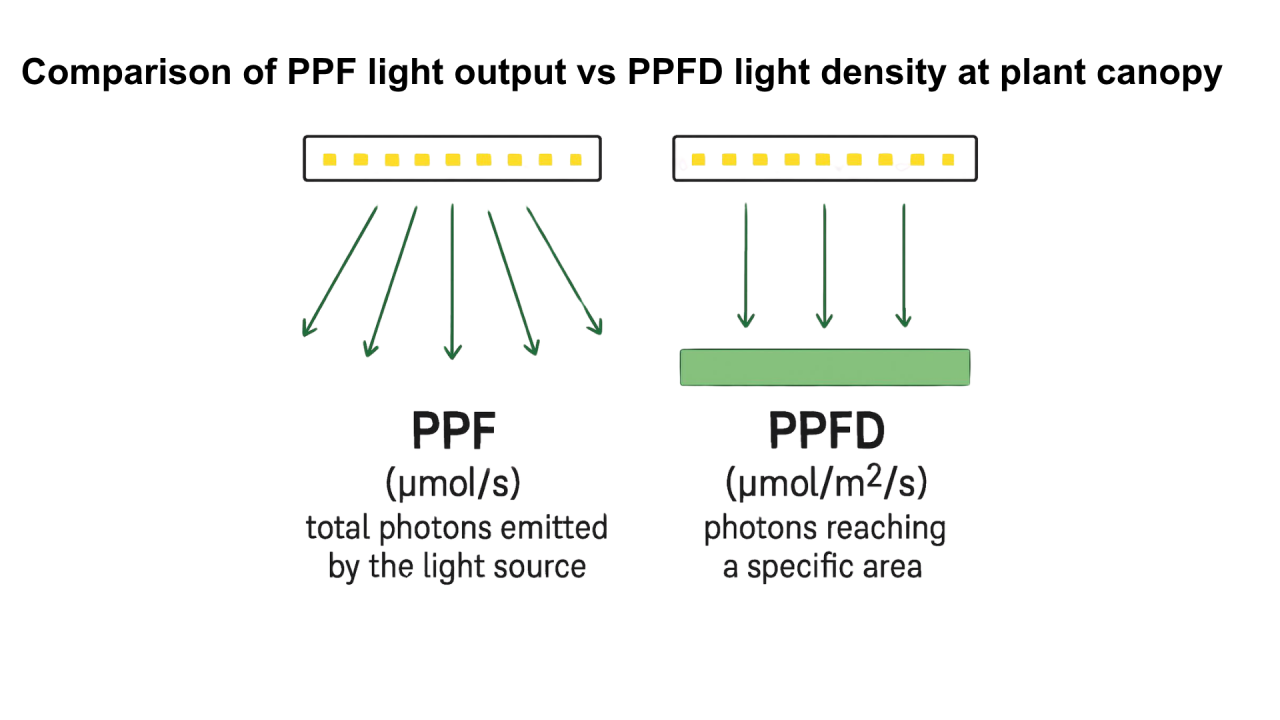
The most consequential measurement misunderstanding in horticulture lighting procurement is the confusion between PPF and PPFD — and it is worth being precise, because the difference between them is the difference between a luminaire specification and a plant performance specification.
PPF (Photosynthetic Photon Flux), expressed in µmol s⁻¹, is a property of the luminaire. It measures the total number of photosynthetically active photons the fixture emits per second, regardless of where they go. It is a useful figure for comparing LED component and system efficiency, but it tells you nothing about what any individual plant actually receives.
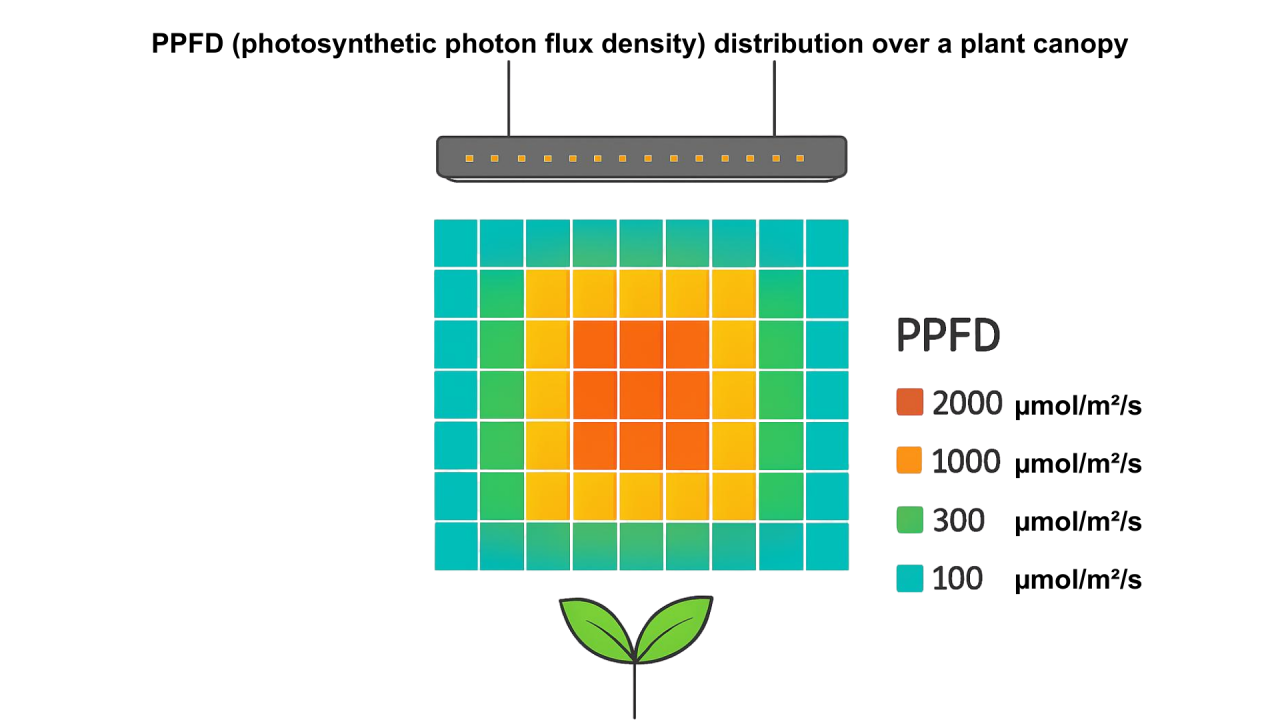
PPFD (Photosynthetic Photon Flux Density), expressed in µmol m⁻² s⁻¹, characterises what actually arrives at a specific point on the plant surface — the number of PAR photons falling on a unit area per second at a given location. This is the number that drives photosynthesis rate. It depends not only on the luminaire's PPF output but on mounting height, beam angle, fixture spacing, and reflections from surrounding surfaces. The same luminaire can deliver very different PPFD values at different points across a growing area, depending on how it is installed and how its light is distributed.
A luminaire specification that quotes only PPF without PPFD measurements at defined mounting heights and spacings is fundamentally incomplete for installation planning. Many LED lighting system manufacturers do not provide PPFD measurements, because PPFD is determined not just by the fixture but by the installation geometry — and publishing a single PPFD figure without specifying the measurement conditions can mislead buyers. Specifying and verifying PPFD at canopy level under actual installation conditions is the only meaningful performance metric for plant growth purposes.
PPFD Uniformity: What the Ratio Means
PPFD uniformity is expressed as the ratio of minimum to average PPFD across the growing area (min/avg ratio). A uniformity ratio of 0.7 means the least-lit area receives 70% of the average PPFD. For a system targeting 250 µmol m⁻² s⁻¹ average, that represents a minimum of 175 µmol m⁻² s⁻¹ — potentially below the effective threshold for certain crops, while the maximum in hot-spot zones might simultaneously be above the light saturation point.
Most leafy vegetables reach their light saturation point between 200 and 400 µmol m⁻² s⁻¹. Adding photons above this threshold in already well-lit zones produces diminishing returns and, at sufficiently high PPFD, begins to suppress photosynthesis through photoinhibition. A non-uniform installation that creates hot spots above saturation while leaving troughs below the effective minimum is simultaneously wasting energy and limiting yield — a doubly costly outcome that better optical design resolves without adding electrical power.
Why Bare LEDs Cannot Deliver Uniform PPFD
An unmodified LED emits light across a wide range of angles. The standard Lambertian emission profile means intensity falls off as a cosine of the angle from the perpendicular, with significant emission all the way to 90° from the optical axis. In a horticulture installation, this uncontrolled profile creates predictable problems.
At typical mounting heights — 0.3–1.5 m in vertical farms, 3–8 m in high-wire greenhouses — a bare LED's footprint at canopy level is a gradient: bright at the centre directly below the LED, falling progressively toward the edges. Between fixtures, PPFD drops to the sum of the contributions from adjacent LEDs, creating a regular pattern of bright peaks and dim corridors across the canopy. Increasing fixture density raises both the peaks and the troughs, but the non-uniformity pattern persists — it cannot be resolved by adding more of the same fixture.
Secondary optics reshape the emission pattern. The beam angle can be narrowed or widened, the intensity distribution can be made more uniform (flat-top rather than peaked), and the emission can be shaped to match the rectangular or irregular geometry of a growing bed rather than a simple circle. This is the function of precision optics in horticulture LED modules: to maximise the fraction of emitted photons landing within the target PPFD range across the growing area — minimising waste while achieving the uniformity specification.
Primary Optics: Uniformity Designed Into the LED Package
Primary optics are integrated into the LED package itself. For most horticulture applications, primary optics provide the first level of beam control — often sufficient for some installation geometries, and the foundation on which secondary optics build for more demanding specifications.
Osram Batwing Primary Lens
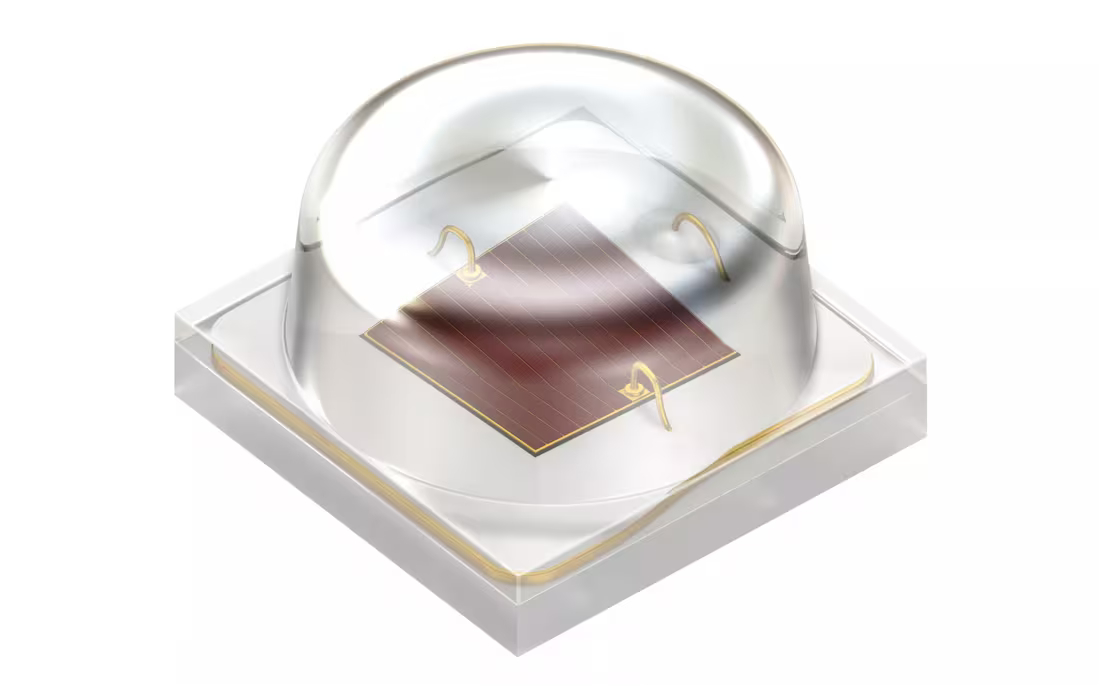
The most commercially significant primary optic development for horticulture is the Osram Batwing lens, available across the full Hyper Red, Deep Blue, Far Red, and Horti White product range. The Batwing profile creates a characteristic double-peaked or wide flat-top emission pattern — substantially wider than a standard dome lens — specifically designed for high-wire greenhouse applications where luminaires are mounted several metres above a wide crop canopy.
The practical consequence is direct: a Batwing lens achieves better PPFD uniformity at canopy level from a single luminaire position, which enables a reduction in the total number of fixtures required to meet a given uniformity specification across the greenhouse. The investment in Batwing-equipped luminaires over standard lens versions reduces fixture count, reduces installation labour, and reduces the long-term maintenance cost of the lighting system. For large greenhouse projects, this compounding benefit makes the Batwing optic a design decision with clear economic as well as agronomic value.
Cree Horizon LED Primary Beam Profile
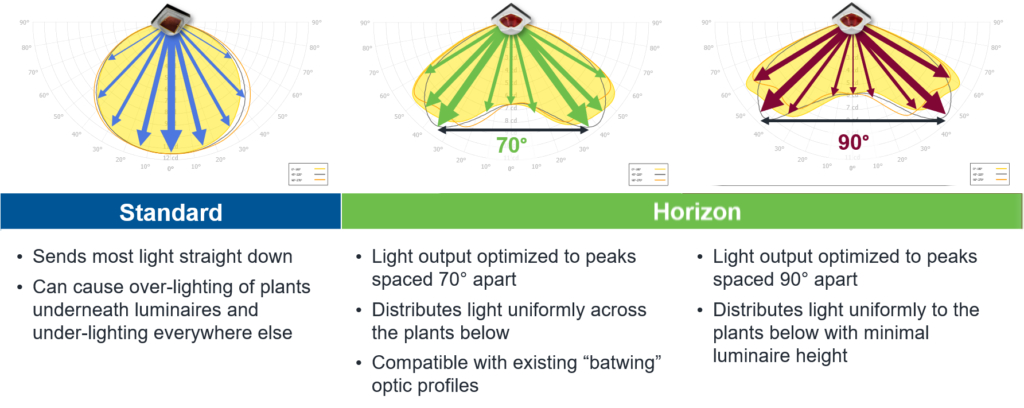
The Cree Horizon LED uses a primary beam profile designed specifically for close-canopy vertical farm applications. Standard high-power LEDs create intensity hot spots when placed closer than approximately 20–25 cm to the plant canopy — a constraint that limits how tightly growing tiers can be stacked in a vertical farm. The Horizon beam profile distributes light more broadly at short throw distances, enabling placement up to 40% closer to the canopy than standard LEDs while maintaining similar PPFD uniformity and achieving up to 10% higher light levels.
In a vertical farm where inter-tier spacing is fixed by the rack structure, the ability to reduce mounting height directly translates into the ability to add more growing layers per metre of facility height. This is a structural efficiency gain — more crop area per unit of real estate — that flows from a primary optic design decision, not from adding power.
Secondary Optics: The Precision Optical Layer
Secondary optics — separate lenses or reflectors placed in front of the LED after mounting — provide finer beam control than primary optics and are the tool of choice when a specific installation geometry demands a precisely defined distribution profile. Lumistrips works with the four leading secondary optics manufacturers globally as authorised distributor and design partner.
LEDiL (Finland): High-Precision Lens Portfolio
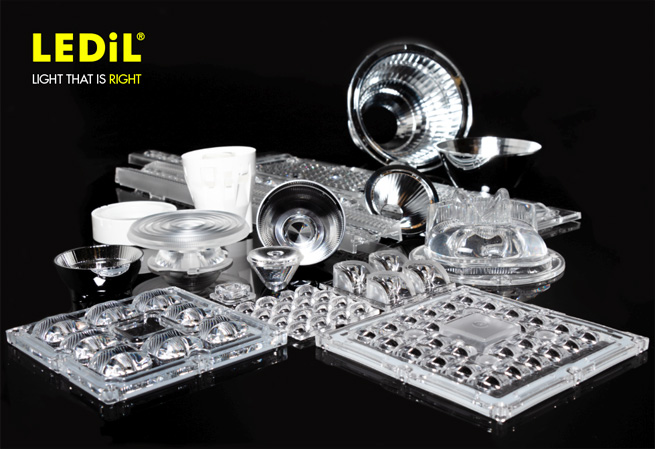
LEDiL is the global leader in high-precision secondary optics for LED lighting. Their horticulture-relevant portfolio spans beam angles from narrow spot through very wide flood profiles, with specific lens families optimised for compatibility with the Osram and Cree XP footprint packages that form the basis of most commercial horticulture LED designs. Lumistrips is an official LEDiL distributor with access to the full product range including custom-specification optics for applications where catalogue products do not meet the requirement.
LEDiL's LISA family, for example, provides asymmetric beam profiles that direct light along the row axis in greenhouse strip lighting — reducing spill into the aisle while maintaining high uniformity across the growing bed width. This type of row-optimised distribution is only achievable through secondary optic design; no primary optic can provide it.
Carclo Optics (UK): Precision Moulded Polycarbonate and Acrylic
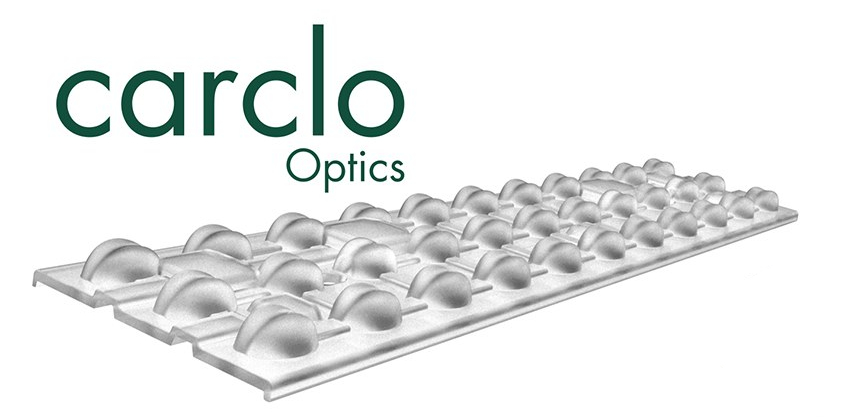
Carclo Optics specialises in precision-moulded polycarbonate and acrylic secondary optics with extensive compatibility across leading LED packages. Their lens families provide beam angles from tight spot (suitable for tissue culture and targeted supplemental lighting applications) through to wide flood profiles for overhead greenhouse use. Lumistrips is one of a small number of internationally authorised Carclo distributors, with access to their full range of lenses, reflectors, lens holders, and accessories.
Gaggione (France): Custom Optic Development
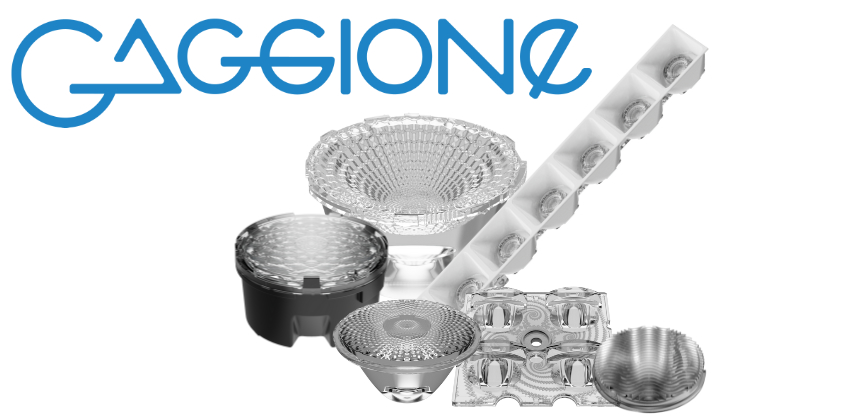
Gaggione offers complete design, development, and manufacturing of custom optical components. Their capability is particularly valuable for bespoke horticulture applications where standard catalogue optics do not meet the installation's specific beam angle or uniformity requirement — Gaggione can develop and manufacture a new optic to specification. Lumistrips is an official Gaggione distribution partner for Europe with a focus on the DACH region.
Optical Design by Installation Type
The correct optic specification is always installation-specific. The following covers the key optical design logic for the main horticulture installation formats.
High-Wire Greenhouse Overhead Lighting
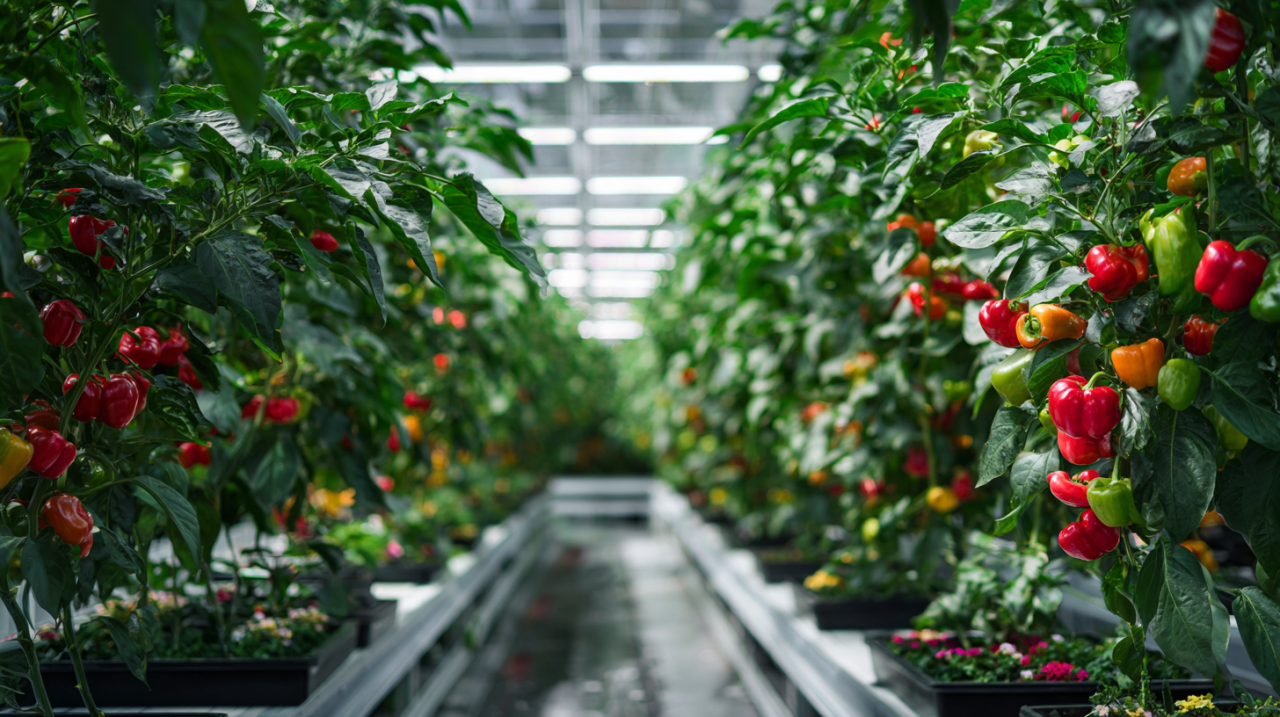
At 3–8 m mounting height above crop rows 0.6–1.0 m wide, the primary optical requirement is wide, uniform coverage. Wide-angle secondary optics (80–120° beam angle) or Batwing primary lens profiles achieve the flat-top distribution needed. For large installations, improving uniformity through optical design reduces the total fixture count required for a given average PPFD target, delivering compounding capital and installation savings that outweigh the incremental cost of higher-specification optics.
Vertical Farm Close-Canopy Tier Lighting
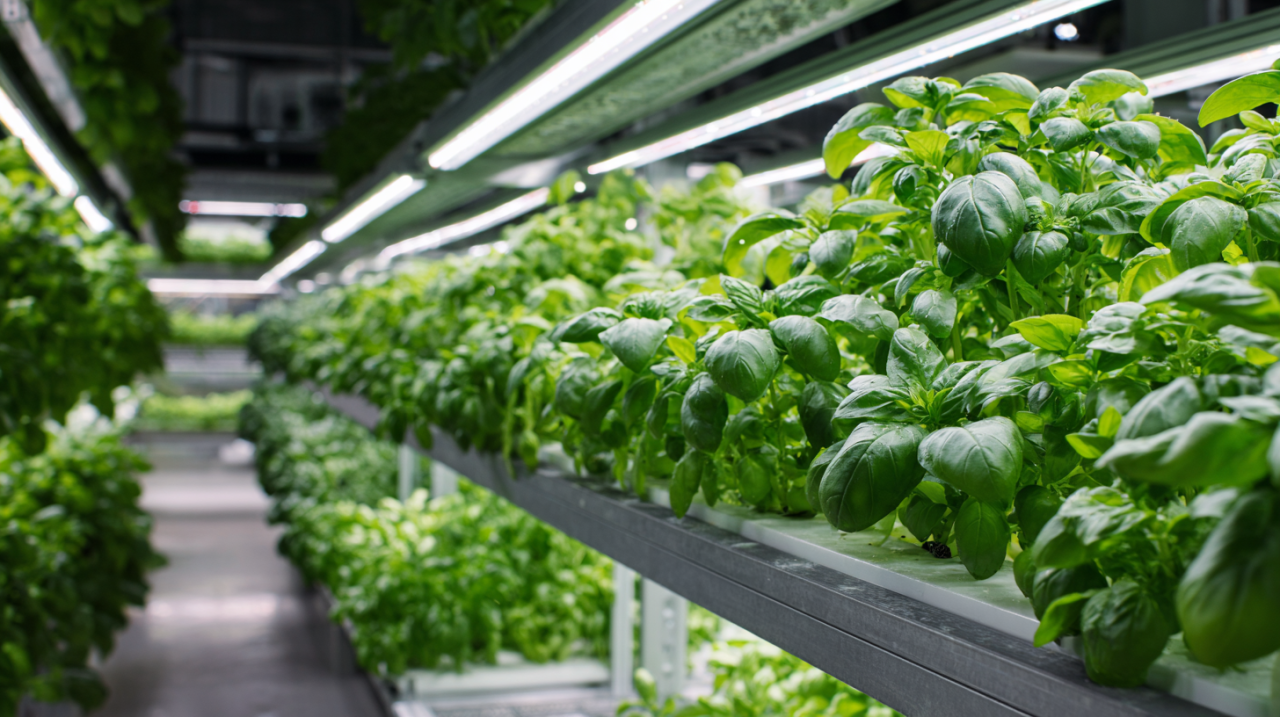
At 15–40 cm mounting distance in vertical farm tiers, the challenge is achieving uniform distribution across a small growing area at very short throw distances. Narrow to medium beam angles (40–80°) combined with careful strip spacing optimise uniformity. Strip layout should account for end-effects — lower PPFD at strip ends relative to the centre — which become significant at very short mounting distances and can be mitigated through optic selection and strip overlap design.
Intra-Canopy Inter-Lighting
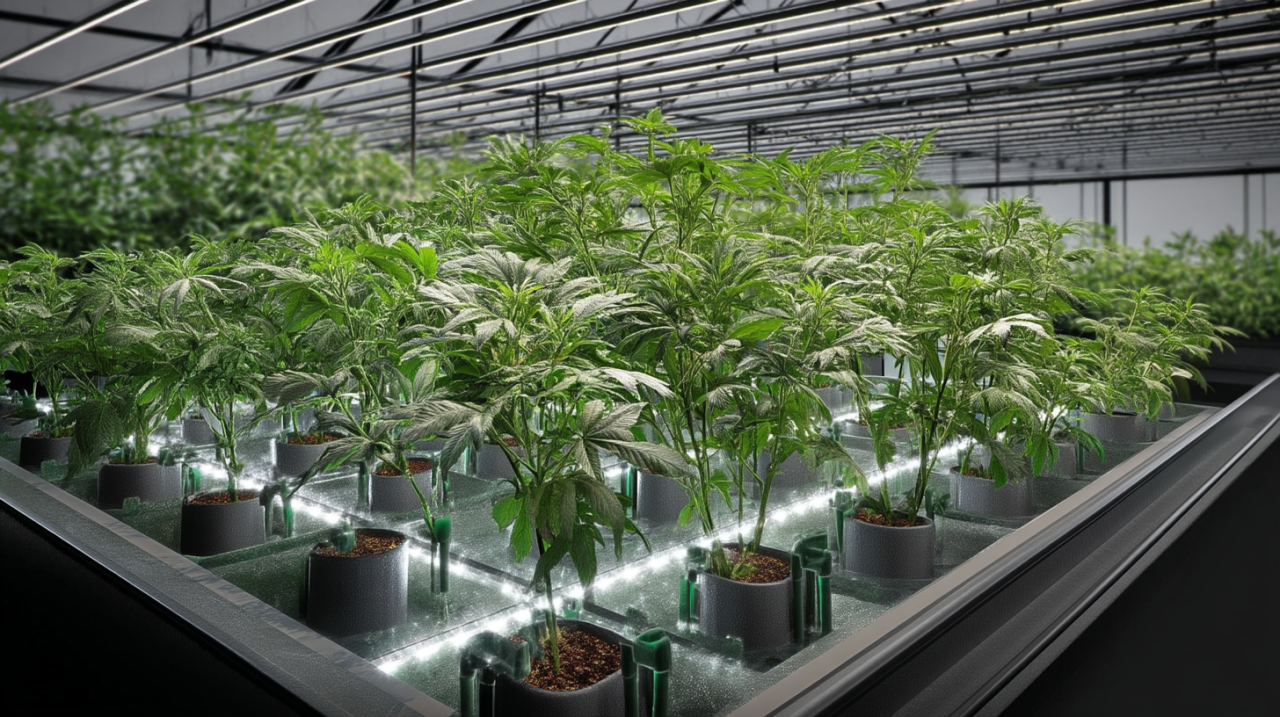
LED bars mounted within the canopy at mid-height must deliver light to mid-canopy tissue without directing energy sideways into adjacent rows or upward into the already-lit upper canopy. Narrow downward-directed optics (20–40° beam angle) are standard for this application. ARI silicone optics are particularly appropriate here, given the direct exposure to plant material, humidity, and cleaning agents that intra-canopy bars experience throughout their life.
Tissue Culture and Propagation Facilities
Tissue culture requires precise, uniform illumination of small trays at 15–25 cm mounting distances, with tight edge control to prevent spectral crosstalk between adjacent trays under different lighting treatments. Narrow-angle lenses (20–40°) with defined edge profiles are the specification. Manufacturing precision in LED placement — Lumistrips' automated SMT production achieves ±0.1 mm placement accuracy — is itself part of the optical performance specification at these close distances.
Accounting for Optical Losses in System PPE
Every optical element in the light path introduces some transmission loss — typically 5–15% for a quality secondary lens or reflector. These losses must be accounted for in the system photosynthetic photon efficacy (PPE) calculation. A luminaire with a system PPE of 3.0 µmol J⁻¹ before optics may deliver effectively 2.6–2.85 µmol J⁻¹ to the canopy after a secondary lens is added. The delivered PPE — after all optical elements — is the relevant metric for energy efficiency assessment in a real installation, not the pre-optic figure quoted in most luminaire specifications.
Polycarbonate optic transmission also degrades under sustained UV exposure. For systems incorporating UV wavelengths — either for disease suppression or as part of a full-spectrum design with UV-A content — silicone optics are the technically correct choice, maintaining higher delivered PPE over the operational lifetime of the system compared to polycarbonate alternatives that yellow and absorb progressively more of the incident light.
PPFD Verification: Confirming the Design Delivers
Specifying target PPFD uniformity is one step. Verifying that it is actually achieved at canopy level after installation is another — and it is a step that is frequently skipped in horticulture lighting commissioning, with consequences that only become visible in uneven crop development weeks into the growing cycle.
PPFD measurement requires a calibrated quantum sensor with a flat spectral response across the 400–700 nm PAR range. Standard silicon photodiodes give incorrect readings under narrow-band LED spectra because of their wavelength-dependent response — a spectrally corrected quantum sensor is required for accurate measurement under LED grow lighting. Measurements should be taken at multiple grid points across the growing area, with results used to calculate the min/avg uniformity ratio and identify hot spots or dark zones.
Modern spectral sensors — such as the ams OSRAM AS7343 — can simultaneously measure total PPFD and spectral composition at canopy level. This enables verification not only of total photon delivery but confirmation that the spectral balance specified in the module design is actually reaching the plants, accounting for any spectrally selective absorption by glazing materials or reflections from growing surfaces. A grower who can confirm that the 91:9 red/blue ratio specified for their lettuce crop is being delivered at canopy level has a measurably more reliable production system than one operating on the assumption that fixture output equals canopy input.
The Economics of Getting Optics Right
The economic argument for investing in high-quality optics is frequently undervalued in horticulture lighting procurement. Optical performance rarely appears as a line item in fixture specifications, and the financial consequences of poor uniformity — lower crop output per unit energy, non-uniform maturity, sorting losses at harvest — are diffuse and hard to attribute directly to the lighting design in routine operations.
The direct economic case is clearest in large greenhouse installations. A Batwing primary lens or a well-selected wide-angle secondary optic that allows a 15% reduction in fixture count for the same uniformity specification represents a direct saving in fixtures, wiring, installation labour, and ongoing maintenance that compounds over a 7–10 year system lifetime. For a greenhouse with several hundred luminaires, this saving from a single optic design decision made at the module specification stage can be substantial.
The indirect case — consistent canopy uniformity producing consistent crop quality — is operationally real even if harder to quantify. Commercial produce operations that require consistent product size, maturity, and appearance depend on consistent growing conditions. A lighting system that delivers reliable PPFD uniformity across every growing bay produces the crop consistency that professional operations require, and a system that does not creates operational costs that persist for the life of the installation.
How Lumistrips Integrates Optics Into Horticulture Module Design

At Lumistrips, optic selection is integral to every horticulture LED module specification — not an optional add-on evaluated at the end of the design process. For each project, the installation geometry is defined first: mounting height, growing area dimensions, target PPFD, target uniformity ratio, and specific constraints (aisle width, canopy density, worker access). From that geometry, the required beam angle and distribution profile are calculated, and appropriate lenses or reflectors are selected from the LEDiL, Carclo, Gaggione, or ARI catalogues — or specified as a custom development where standard products do not meet the requirement.
Optic selection is validated against LED package footprint compatibility before module design is finalised: every secondary optic is designed for specific LED footprints, and the combination must be confirmed to avoid optical misalignment that would compromise the distribution profile. Lumistrips' direct relationships with all four optics manufacturers, combined with component partnerships with Nichia, Cree, Osram, Seoul Semiconductor, and LumiLeds, enable design across the full combination space — matching the right optic to the right LED for each application.
The result is a horticulture LED module where delivered PPFD at canopy level is an engineered specification verified against the installation geometry, not an estimate extrapolated from a fixture output figure. That difference is the gap between a lighting system that performs as designed and one that performs as hoped.
Need PPFD uniformity analysis or optics specification for a horticulture LED project?
Lumistrips integrates secondary optics from LEDiL, Carclo, Gaggione, and ARI into custom horticulture LED modules engineered for specific installation geometries. Our team works through mounting height, growing area dimensions, and PPFD targets to specify the right optical solution for your greenhouse or vertical farm application. Talk to our horticulture lighting engineers.
← Back to the series: LED Lighting for Horticulture — The Complete Engineering Guide







